

Northwestern artists reflect on 2020 Indigenous Fashion Week Toronto
By Rick Garrick
TORONTO — A group of artists from across northwestern Ontario appreciated the opportunity to showcase their work through Indigenous Fashion Week Toronto’s Northwestern Ontario Spotlight virtual exhibition in late November.
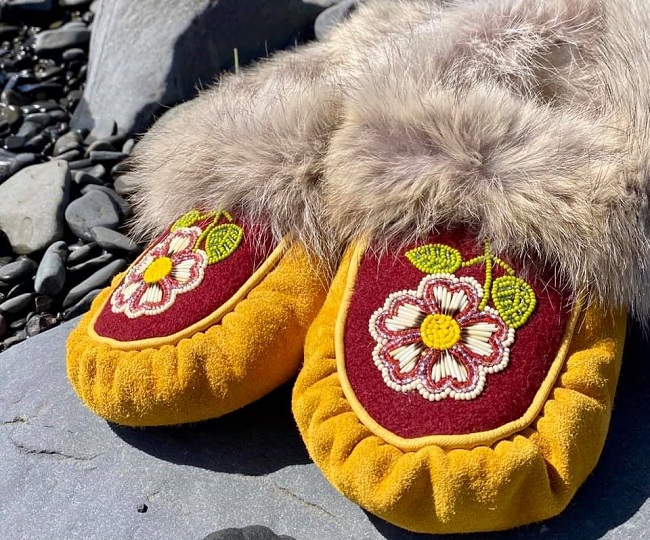
“It went really well for me — all my items sold within the first day,” says Sheila Demerah, a Fort William citizen. “I had six pairs of moccasins and four pairs of earrings. My moccasins have seed beads and quillwork, and I had some that were trimmed in coyote fur, some that were trimmed in beaver. And I actually did one with some polar bear and arctic fox that somebody had given me.”
Demerah says she used the quillwork on the vamp of the moccasin to create a “natural burst from the centre out” effect among the petals of the seed bead flowers.
“I don’t colour them, I use the natural colour,” Demerah says.
Demerah says some people have since reached out to her to purchase other pieces of her work, noting she has an Instagram page to display her work.
“This was the first time … that I tried doing earrings,” Demerah says, noting she used seed beads and quills to create the earrings. “My sister encouraged me to try and a lot of people liked them — they’re bright, they’re fun, they’re things people can wear and people can afford them.”
Demerah says the artists were also provided with a workshop by the Indigenous Fashion Week Toronto organizers in early 2020 on how to start a business, how to value their work and how to talk to media.
“We had to learn how to tell our story— so who we are and why we do what we do,” Demerah says.
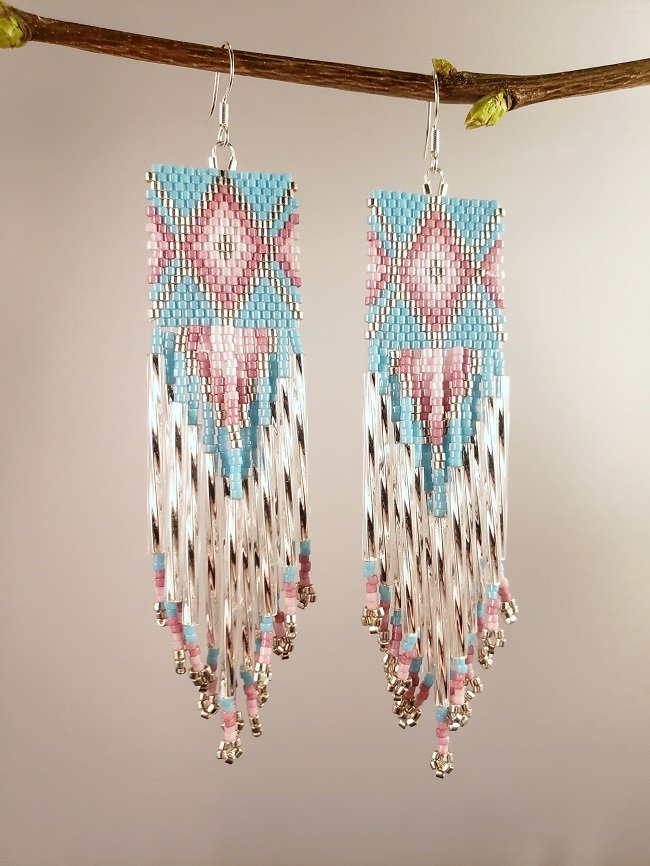
Kathleen Sawdo, a Lac Des Mille Lacs citizen whose grandmother was from Fort William and owner of Sister Bear Designs at the Thunder Bay Country Market, says the virtual exhibition was an opportunity to share her work with a wider audience.
“It was an amazing experience, especially being from the north and Thunder Bay area, having that opportunity to widen and broaden the audience and customer base,” Sawdo says. “I sold five pieces or sets. Our square top beaded earrings, they’re longer earrings and they kind of have a sparkle and shine to them and we use long glass beads, those sold almost right away. We sold a jingle barrette, so we used an Anishinaabe Bimishimo jingle tin and then we beaded around to make them into a barrette.”
Sawdo says she has also received some orders for her work and has been contacted by other people about her work since the exhibition.
“I’ve been contacted from someone in England so it’s just really broadened to an international level,” Sawdo says.
Sawdo says she usually sells work by herself and her family at the Thunder Bay Country Market, which is usually open on Saturday mornings and Wednesday evenings.
“For me and my family, it’s our time of ensuring our stories and everything is passed on, they stay alive,” Sawdo says. “It’s also important to do these events because we get authentic Indigenous hand-made creations, and with that it’s generations of knowledge in that one piece that you create.”
Jean Marshall, a Kitchenuhmaykoosib Inninuwug citizen who lives in Fort William and curator of the exhibition, says the Indigenous Fashion Week Toronto organizers decided to hold an online edition, with the virtual exhibition, after the originally scheduled festival was cancelled due to the coronavirus disease 2019 (COVID-19) pandemic.
“We were given the opportunity to showcase up to 10 items,” Marshall says. “For the emerging artists, it was really great because their work was showcased for the first time and they had an opportunity to experience the excitement of that. It’s an international event — people from all over the world were tuning into the event and really wanted to see what makers and designers are up to.”