

STEM Summer Camp inspires next generation of leaders
By Rick Garrick
THUNDER BAY — Ontario First Nations Technical Services Corporation (OFNTSC) held a STEM Summer Camp featuring land-based learning, tech presentations, group mentorship sessions, and a keynote on July 30 at Delta Hotels Thunder Bay.
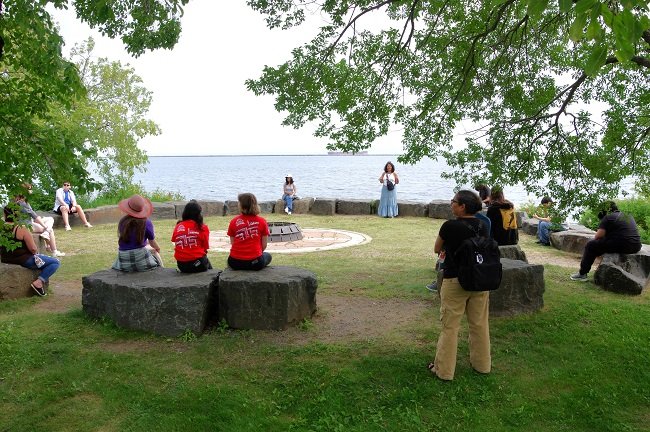
“I thought it was a perfect opportunity to tour the Spirit Gardens to check out the medicines that are locally-grown and also to show them the sights and the land down here, how beautiful it is,” says Genevieve Desmoulin, cultural resource coordinator at Thunder Bay Indigenous Friendship Centre and Biigtigong Nishnaabeg citizen. “It was well received; we engaged the youth, they enjoyed the little walk and it was a perfect time. It’s really important for our youth to become engaged in these types of programs because it opens their eyes to other employment opportunities, potential careers that they could have, and it’s building a whole generation of future leaders.”
Desmoulin also spoke about how sage and other plants are ready for harvest earlier than usual this year.
“I thought it was going to be a [bad] season for forest fires, I was like, ‘The blueberries, the poor animals, the plants aren’t going to be there,’ but we’ve had a really wet, rainy season and because it’s been so hot and humid, all of our plants are growing a lot faster,” Desmoulin says. “So right now, sage has been ready to pick.”
Charmaine McCraw, manager of Indigenous engagement and training at Origin and Biigtigong Nishnaabeg citizen, says they did a demonstration of Origin’s ImmersiveLink VR technology during the STEM (Science, Technology, Engineering and Math) camp.
“The camp is really about getting youth interested in careers in STEM and with our ImmersiveLink system, we’re able to kind of show them about 12-15 different careers that fall within those (STEM) categories,” McCraw says. “So, they were taking about 20 minutes each and going through the ones that interest them, just giving them a little bit of a peek into what that career might be for them.”
McCraw says the demonstration was good, noting that youth always enjoy using the VR equipment.
“It really kind of opens them up to a new world that they might not ever get to see,” McCraw says. “They like new technology and the one thing is just getting them used to the controls and getting them into the right spaces in those headsets.”
Melanie Debassige, executive director at OFNTSC and M’Chigeeng citizen, says there is a huge shortage of plumbers, electricians, infrastructure specialists, inspectors, and engineers.
“In order to build our communities and make them what they are, you need to have those foundational people that go in there and put in the schools, put in the water treatment plants, put in the waste water treatment plants, put in the roads, put in the bridges, put in the houses, inspect the houses, ensure that our buildings are safe,” Debassige says. “What we’re trying to do is encourage youth here today to get into those fields and potentially, we’re hoping this can be a part of our succession plan where maybe they could come and work for OFNTSC. If they work for us for a couple of years to get that experience, whether it’s through an internship, they can take that back to their communities because you’re still doing that capacity-building.”
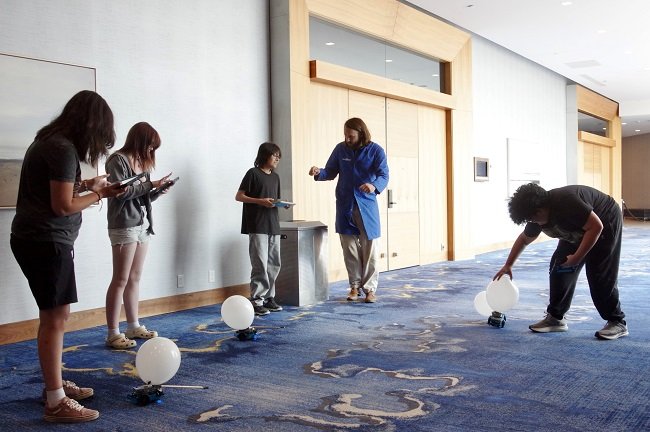
David Bates, STEM specialist for Indigenous initiatives at Science North in Thunder Bay, says the students were coding robots during his presentation at the STEM camp.
“The students built little miniature user interfaces for controlling robots and they control the speed, [how] the different motors work and then they added a small pick at the end of it — balloons were the target,” Bates says. “It went really well, they seemed really receptive. Who doesn’t love having robots that pop balloons?”
Theland Kicknosway, a youth activist, role model, and educator from Walpole Island, delivered the keynote where he highlighted how he took advantage of being at home during the COVID-19 pandemic by learning how to play the flute.
“When we were all stuck inside throughout quarantine and COVID and we weren’t able to see our friends and family, it was pretty tough and kind of difficult not having the face-to-face interactions,” Kicknosway says. “So, I tried to take advantage of that and get closer to my culture to learn more about the flute and to learn about how it can help you in so many different ways, the healing and the medicine from the songs.”