

Book review: The Last President: Autobiography of a Residential School Survivor
 Reviewed by Karl Hele
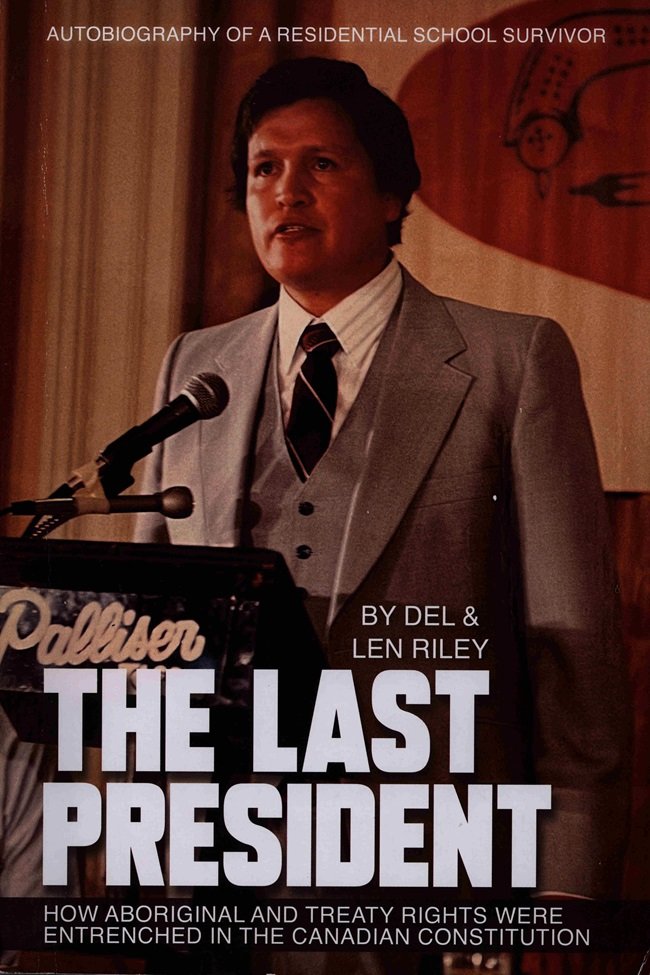
The Last President: How Aboriginal and Treaty Rights Were Entrenched in the Canadian Constitution, is a fascinating autobiography of Chief Del Riley following his life from Indian Residential School to National Chief to Band Chief to activist for the Indigenous cannabis industry. Throughout Riley’s life story, his pride, knowledge, and desire to improve his life and that of Indigenous peoples shines through. His experiences in Residential School and with the Canadian state continue to shape his advocacy for Aboriginal rights.
Riley’s autobiography can be broken down into four sections. The first section describes Riley’s Residential School experiences beginning in 1950 at age 6 when he was enrolled in the Mohawk Institute or Mush Hole. In these chapters, he compares the Mush Hole, and all Residential Schools, to concentration camps where human rights and dignity were stripped away and children became forced labour or slaves for the various churches.
The second section follows his adventures as a young man, including harassment and intimidation by the Royal Canadian Mounted Police and his life in the US, where he experienced freedom, success, and respect denied to him in Canada. While in the US, Riley witnessed the civil rights movement of the 1960s. This experience aided Riley in developing a greater understanding of his Residential School experience and Canadian racism overall while eventually influencing his own efforts for justice in Canada through non-violent means.
The third section deals with Riley’s experiences at the Union of Ontario Indians and the National Indian Brotherhood. This stage of his life began upon his return home in 1970. At the Union, he worked as that organization’s first Land Claims Researcher. His experiences, knowledge, and efforts for various communities led to his election as Union President in 1976. After working for the Union for a decade, Riley became the Chief of the National Indian Brotherhood, a position he served in from 1980-82. During this key period in Indian history, Riley negotiated with Liberal Prime Minister Pierre Elliot Trudeau and the Provincial Premiers to ensure that Aboriginal rights were enshrined in the Canadian Constitution.
The fourth and final section is his work for community and his continued efforts to seek justice.
Riley served as Chief of his own community, Chippewa of the Thames, from 1991-95 and has continued to advocate for Indigenous rights and economic development, including work promoting the Aboriginal cannabis industry. Within this assortment of chapters, the “My Fight For Justice” chapter stands out. Here, Riley offers some poignant criticism of the Indian Residential Schools Settlement. Specifically, he views the settlement as problematic in part because it “exonerated the churches from all other crimes, such as forced labour” (243) or “child slavery” (242), while Canada “failed in [its] fiduciary obligation to protect my best interests and that of all survivors”(243). This section is enlightening on some of the failings of the Residential School commission.
Riley’s ‘Final Thoughts’ or conclusion returns to the themes of the autobiography that focus on racism in Canada, especially his efforts to promote and secure Aboriginal rights. His only regret is being unable to eliminate the Indian Act, the foundation of Canada’s apartheid system, but he remains jubilant over his success in securing section 35 in the Canadian Constitution for, according to Riley, it “far exceeded any boundaries of the Indian Act.” (277).
Taken altogether, Riley has had an incredible journey with varied experiences where he acquired a considerable amount of experiential and academic knowledge about the Indian Act, politics, and Aboriginal rights. The Last President is a marvellous contribution to the literature, especially since it expands our understandings of Residential Schools while adding to our knowledge of how section 35 came into existence. As an autobiography, Riley’s life and message is incredibly important for our current leadership as well as the next generation. The Last President should be read by everyone.
Del and Len Riley, The Last President: How Aboriginal and Treaty Rights Were Entrenched in the Canadian Constitution. Tyendinaga Mohawk Territory: Real People’s Media and Ajijuk Publications, 2023.