

Sheguiandah First Nation Nini shares teachings on implementing the Doodem System of Governance
By Rick Garrick
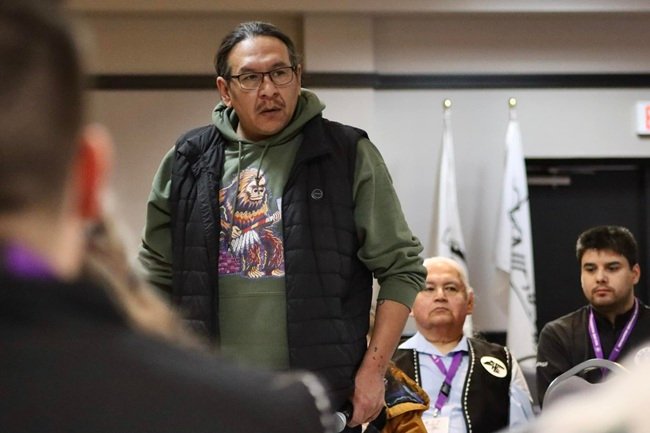
SAULT STE. MARIE — Sheguiandah First Nation’s Chop Waindubence shared teachings on Implementing the Doodem System of Governance on the second day of the Anishinabek Nation Governance Summit, held Feb. 25-27 at the Quattro Hotel and Conference Centre in Sault Ste. Marie.
“Each one of these clans have leadership instilled inside of them and we have to make sure that we use that leadership as well,” says Waindubence, whose father was the late Anishinabek Nation Head Getzit Mishomis Gordon Waindubence M’Shiikenh-baa. “These clans are not the only leadership we have in Anishinabek territory, and throughout the day, I’m going to reflect back on that because we have to understand where our leadership comes from and what leadership really is. And I know we always bash the Indian Act, and I’m going to bash it right now for a minute — act Indian, not Indian Act, like the old man (Gordon-baa) said.”
Waindubence says one of the differences between the Anishinabe people and the federal and provincial governments is how the governments provide people with little booths so they can vote in privacy at the polling stations during elections.
“We never kept secrets as Anishinabe people, we were in the open about everything,” Waindubence says. “We would stand up behind the one that we wanted to follow, this is where the stand-up election came from, Anishinabe country. This would be happening in our clans as well, how we pick leadership, the ones that would have that voice, and we would follow them, we’d support them and we wouldn’t be afraid to show it, no matter if it was family or not.”
Waindubence says they also need to make sure children and youth are included when passing on teachings, knowledge, and language.
“Inclusion is the most important thing, and we always talk about it, we talk and talk until we’re blue in the face, but we never do it,” Waindubence says. “Where’s our youth council? Where’s our women’s council? These are the things we have to include, these were instilled in our teachings, these were instilled in Anishinabe territories, we cannot forget about those.”
Waindubence says each of the clans has a duty and responsibility for the sovereignty of the communities.
“Each one of these has an important role in our communities because how many teachings do we have? Zaagidwin (love),” Waindubence says. “One of these clans holds unconditional (Zaagidwin), and that’s the Otter, for a reason. It’s unconditional because they will sleep in the water and hold their partner’s hand or their children so they don’t lose them, and they will sacrifice their life for that one. That’s how powerful those teachings are and we have to remember that.”
Waindubence says each of the clans on display at the Summit have 42 subcategories.
“I think it’s time to start breaking those down to show the relevance of our communities, to show how impactful each and every one of these clans really are,” Waindubence says. “All of these teachings combined, it’s in the [Anishinaabe Chi-Naaknigewin (Anishinabek Nation Constitution)] preamble, what it says — Debenjiged kiimiingona dedbinwe wi naagdowendiwin — the Creator gave us sovereignty to govern ourselves and it’s time to start acknowledging and understanding how much governance really is structured in Anishinabe territory.”
Waindubence adds that each of the sacred items on the blanket in the circle at the Summit has a specific purpose and role.
“Can we just leave this (Talking Stick) down on the ground?” Waindubence asks. “What does that mean? We’re not in session.”
Waindubence also stressed the importance of Anishinaabemowin, noting that the translations of English words do not translate exactly, such as the translation of money, which means something that shines.
“That’s the difference with our language, our language is very important to have,” Waindubence says. “We heard it this morning, that a lot of these English words, they don’t have meaning in our language, we can’t translate them, just like Zaagidwin, what does Zaagidwin really mean? It’s a lot more difficult than we realize because we cannot translate that word because it talks about something beyond us as an understanding. This is how difficult it is to understand our language.”
Waindubence says the word Debwewin (truth) is actually Odebwewin.
“This is why that truth hurts is because we’re speaking from here, Ode (heart),” Waindubence says. “These are instilled in our clan teachings, each and every one of these things. When we use them as a governance structure, we have to make sure we explain the past, we have to make sure we explain the present, how would those affect us in the present day right now, today? Those people that speak on that podium back there, debwe, they have to speak that truth.”
Livestreams of the three days of the Anishinabek Nation Governance Summit are posted at the Anishinabek Nation YouTube page.