

Community comes together to say ‘no’ to nuclear waste
By Rick Garrick
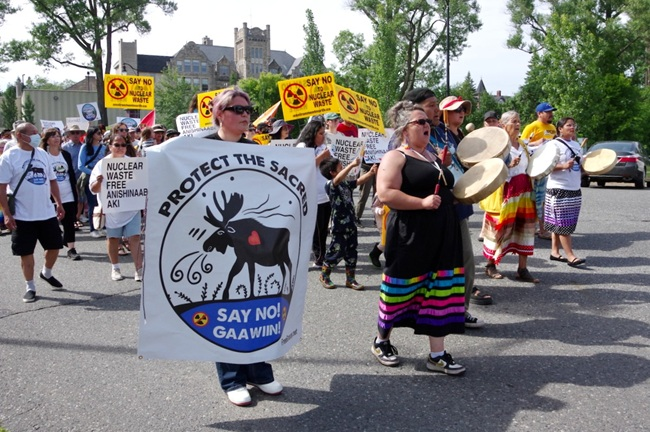
THUNDER BAY — Fort William Chief Michele Solomon marched with leaders, Grassy Narrows citizens, and concerned people in opposition to a nuclear waste storage site near Ignace on July 4 in Thunder Bay. The rally and march, which began at Waverley Park and ended at the Spirit Garden on the waterfront, was jointly organized by citizens from Grassy Narrows and representatives from Fort William.
“It’s really beautiful and overwhelming the number of people that have come out to show solidarity [with] our collective effort, our collective interests in saying no to nuclear waste because one voice alone is not enough to put a stop to nuclear waste coming through our communities,” Chief Solomon says. “The leadership of Fort William First Nation has certainly made their voice clear in opposing nuclear waste being transported through our traditional territory, and we stand in solidarity with all the people that have joined together to be strong against this.”
Chief Solomon says she also wanted to acknowledge the people from Grassy Narrows and We the Nuclear Free North who continue to raise awareness of the nuclear waste issue.
“I’m so grateful that I can be here with all of you today and bring words to this issue on behalf of the leadership of my community and my community members to say that we stand with all of you,” Chief Solomon says. “Together we can make a difference, together we can be strong, together we can say no to nuclear waste and hopefully put a stop to nuclear waste coming to this territory, coming to threaten our lives here in this area.”
Nishnawbe Aski Nation Grand Chief Alvin Fiddler stressed how the leadership of Nishnawbe Aski Nation had declared their territory a nuclear-free zone more than 30 years ago.
“We’re here today because we love our land, we love our waters, and we care about our children’s future,” Grand Chief Fiddler says. “And for our leadership at Nishnawbe Aski Nation, we’ve been very clear, even going back over 30 years when they first passed a motion at one of our assemblies to declare Nishnawbe Aski Nation a nuclear-free zone. We don’t want nuclear waste, even within our territories. Even though we get reassurances from those that are promoting this project that the risks are minimal, we know that the risks are high, too high.”
Grand Chief Fiddler says they care about the communities that could potentially be within the transportation corridor and the communities that live downstream from the river systems along the transportation corridor, noting that if there were an accident, the damage would be great.
“And the damage would be long-lasting — we cannot afford to take that risk,” Grand Chief Fiddler says. “That is why we are here today in solidarity, not just with Grassy Narrows, but those that have said no to nuclear waste, that we stand with you. I call upon those that are promoting this project to look elsewhere to store these dangerous chemicals. We will not be bought off, and we will do everything we can within our powers, with the powers of all those around us, with our allies, that we will say no, that we will oppose this project moving forward. We will consider every option that is on the table to stop this.”
Grassy Narrows citizens Judy Da Silva and Chrissy Issacs also raised their opposition to nuclear waste transportation and the nuclear waste storage facility near Ignace.
“Nuclear waste poses a risk to our way of life, our children and those still to come,” says Da Silva, a mother, grandmother, and mercury sufferer from Grassy Narrows. “We do not agree to this risk. We say no to nuclear waste that will be dangerous for far longer than anything that humans have ever built. We have been poisoned once already, we will not be poisoned again.”
“First Nations have the right to say no to dangerous projects that threaten our lands, our waters, and our people,” says Issacs, a Grassy Narrows mother. “Our communities have lived with the consequences of environmental harm for generations. We will not stand by while the government and nuclear industry try to force this risk on us again.”