

Passing on hide tanning to the next generation
By Rick Garrick
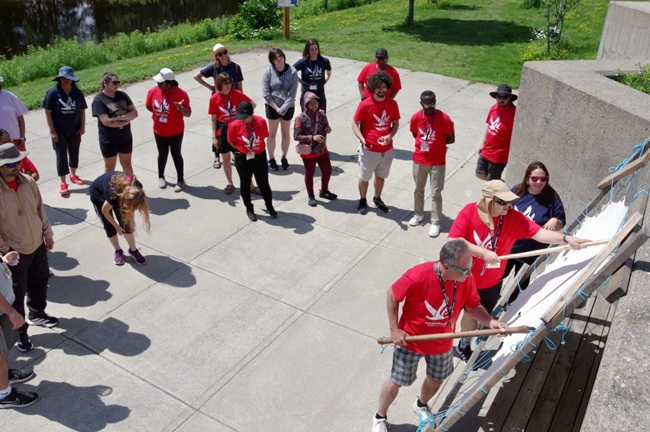
THUNDER BAY — Red Rock Indian Band’s Shardae Fortier enjoyed sharing her passion for hide tanning with teachers during Gakino’amaage’s (Teach for Canada) Summer Enrichment Program on July 17 at Lakehead University in Thunder Bay. The Summer Enrichment Program was held from July 14 to 18 to prepare teachers for their upcoming positions in First Nations across Northern Ontario, Manitoba, Saskatchewan, and Alberta.
“The hide camp portion of the program was new this year and based upon my passion, [we] brought it to the program this year,” says Fortier, vice president of programs at Gakino’amaage. “I started my hide tanning journey five years ago. I started all by myself and realized we need a community to be able to support that undertaking.”
Fortier says she brought in Jean Marshall, her hide tanning mentor, as well as Shelby Gagnon and Charlotte Marten to support her with the hide camp.
“The idea was to really expose teachers to some of the land-based activities that they could do with their students, but also to activate and understand what can come from the animal,” Fortier says. “Even if it’s outside of your comfort area or outside of your values, you can still work with your students to encourage them to get on that land and do traditional practices.”
Marshall, a Kitchenuhmaykoosib Inninuwug citizen, says it was a wonderful experience to share her knowledge with the teachers.
“It made me really happy to see that there’s so many people interested to go work up north,” Marshall says. “I chatted with a lady who’s teaching in Pikangikum and the moose hide workshop that we did this afternoon, it really spoke to her and hopefully in the future our team will get up to Pikangikum and help navigate the hide tanning community there and kind of jump-start the hide tanning there.”
Gagnon, an Aroland citizen, says the hide tanning workshop was super special.
“It’s really special to be able to introduce them to hide tanning before they go up to the northern communities,” Gagnon says. “I think [for] most of them it was their first time hide tanning, so that was very special. I’m very much looking forward to seeing this program continue developing and seeing more land-based arts practices in it.”
Marten, a Kitchenuhmaykoosib Inninuwug citizen, says it was great for the teachers to be exposed to the hide tanning.
“It prepares them to what they can face, cultural stuff, in the communities,” Marten says. “For me, I did a lot of language with them, simple basic language words that they can utilize. I think it’s really good for the community and good for the [teachers] not to have a culture shock when they go into the communities.”
Fortier says one of the language instructors in the Summer Enrichment Program, Danny Peters from Pikangikum, shared a story about how his grandmother used to work on hides when he was young.
“And it was just coming back to him as he was working with the hides,” Fortier says. “He really immersed himself as well and really loved that part of the experience, because he also mentioned that in his community there is no one currently doing hide tanning.”
Peters says he remembered how his grandmother used to work on the hides while he watching the hide tanning demonstrations.
“I remembered some of the things she did, like the way she [was] scraping the flesh, scrapping the hair, scrapping all that stuff,” Peters says. “I remembered all those things and the way we used to pull the hide to dry it, and everything else that was there that they showed, I used to watch her do those things.”
Fortier says the teachers are provided with First Nations language lesson sessions during the Summer Enrichment program.
“[We’re] just equipping teachers with the basics that they need to be able to start to run their classrooms in a good way and connect better with their students and build that trust with the students,” Fortier says.
Fortier says they recently received funding to pursue a local bachelor of education program so community members would not have to leave their homes while studying to become certified teachers in their community.
“We really are working with community partners to determine what that program will look like and soon we hope to be able to pilot it within the next three years or so after consultations,” Fortier says.
This year’s Summer Enrichment Program also included a blanket exercise and presentations on land-based learning, trauma-informed classrooms, realities in the north, curriculum planning, SafeTALK training, classroom management, collaborating with EAs, culturally competent teachers, and learning integration.