

Remembering Richard Lyons through film
By Rick Garrick
THUNDER BAY — Long Lake #58’s Sterling Finlayson, owner of Boozhoo Productions, highlighted the story of Richard Lyons in the Remembering Richard Lyons film that was recently posted on the Thunder Bay Museum’s Vimeo page. Sponsored by the Thunder Bay Museum, the film was created by Finlayson and Jim Hyder about how Lyons, a Couchiching citizen from Treaty #3 who passed in 2005, formed the Lyons Dance Troupe in 1969 and helped revive the pow wow in northwestern Ontario.
“[Hyder] told me about what Richard Lyons did in the 1970s and how he brought back culture to a lot of [First Nations] in the surrounding northwestern Ontario area,” Finlayson says. “I was interested, so I told [Hyder] to tell me more and how we would go about doing this.”
Finlayson says they interviewed members of the Lyons family and the Lyons Dance Troupe about their history, progress, and their current situation for the film.
“It was great dealing with him, so we decided to schedule out a bunch of interviews and start the project,” Finlayson says. “We interviewed Kathy Lyons (one of Lyons’ daughters). And then we got his dance troupe — Jeordi Pierre was part of it, he was a kid when he started, and then he grew up into the Dance Troupe.”
Finlayson says some of the people he interviewed were emotional while sharing their stories.
“It wasn’t just a memory to these guys,” Finlayson says, noting that Lyons had helped them to build the lives they lead today. “So they were very emotional when they were saying these stories.”
Finlayson also did interviews with Fort William Elder Marlene Pierre, Netmizaaggamig Nishnaabeg’s Beverly Sabourin, Verna Legarde, one of Lyons’ daughters, and members of the Lyons Dance Troupe, including Biinjitiwaabik Zaaging Anishinaabek Elder Jim Mishquart, Getzidjig Advisory Council Northern Superior Region Representative, Biigtigong Nishnaabeg’s Nathaniel Moses, Lac Seul’s Dave Simard, Ginoogaming’s Cathy Fobister, and Fort William’s Jeordi Pierre, whose School of Indigenous Learning (SOIL) was the location for many of the film interview sessions.
“I think they’re more comfortable doing interviews out on the land, especially when they’re together,” Finlayson says. “That was a great experience for me working with a crowd.”
Jeordi says they had a fabulous day during the film interview sessions with Finlayson and Hyder at SOIL.
“They were very professional, they did an absolutely great job,” Jeordi says. “It was just a great pleasure to work with everyone and to visit with everyone.”
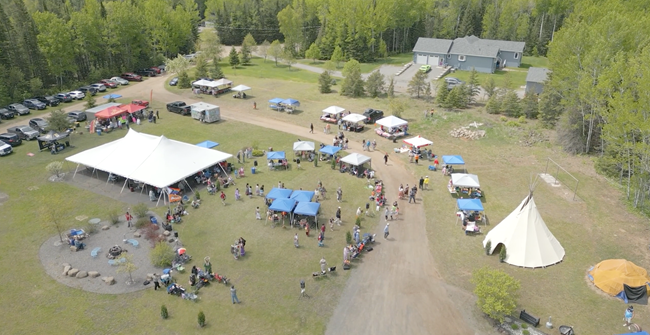
Jeordi says he has been involved with the Lyons Dance Troupe since he was a one-year-old child.
“It seemed like it was a full circle, like how I started dancing at such a young age and then to have [the film interview sessions] hosted here,” Jeordi says. “[My culture] was exposed to me at a young age and then in doing what I’m doing now and trying to educate our young people and educate our people, it just seems like my life was drawn and it was supposed to be like this, about helping our people with their culture. Everything seems to fit in place, it’s just a really big, high honour.”
Sabourin, a member of the film planning group, which included Kathy Lyons, Marjorie Lyons, Legarde, Marlene Pierre, and Hyder, says the film participants spoke about their experiences with the Lyons Dance Troupe and how it affected their lives.
“A lot of these people are now doing a lot of cultural programming, ceremonies, going back to their traditions, and teaching and passing on the legacy of what Richard Lyons had started,” Sabourin says. “So from that point of view, I think the film had shown the greatest impact that [Lyons] had on those individuals and how it continues today because of how he had revived throughout northwestern Ontario and beyond the pow wows and the cultural teachings and traditions — that really speaks to the power of our culture and how it heals and it strengthens and it brings people really close together as a community.”