

Anishinaabe Keeshigun celebrates First Nations culture
By Rick Garrick
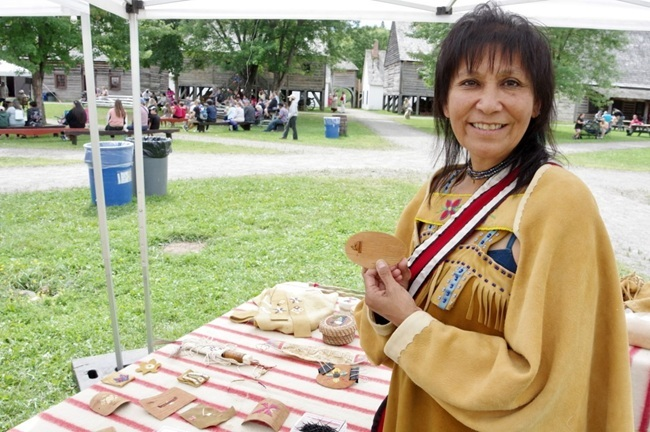
THUNDER BAY – Fort William Historical Park’s (FWHP) Anishinaabe Keeshigun celebration featured a range of hands-on activities and demonstrations, as well as a pow wow with local dancers and drummers on Aug. 16-17 in Thunder Bay.
“This is my first time doing quillwork,” says Beverly Bannon, Indigenous interpreter at FWHP and Fort William citizen, noting that she was being taught by Carla Ryynanen, public programming assistant at FWHP, and Audrey Deroy, a former FWHP staff member. “I’m here being trained by the two ladies that are very knowledgeable about porcupine quillwork. There’s a lot of porcupine quillwork here, and when I first started working at Fort William Historical Park, I said I really wanted to learn skills to bring back our culture, to bring back our traditions.
Bannon says the quills have to be soaked to make them pliable.
“You don’t poke holes all the way, you start from one end and you just work your way to the other end,” Bannon says. “You need a lot of patience, and this is like prayer and this is like taking your time and putting goodness into your work.”
Bannon says they usually get a good response from visitors about the quillwork.
“Their eyes open up wide and they want to check everything out in how it’s made,” Bannon says, noting that the quillwork is very delicate. “When I’m done my quillwork, I’m going to sew sweetgrass on the outer part of the quill barrette. Sweetgrass is very important because it strengthens our mind, our body, and our spirit.”
Fort William Elder Sheila DeCorte highlighted the importance of water during her For the Love of the Rivers 2.0 (2022-2025) water walks presentation at the pow wow.
“Water is alive, we all come from water, we are created in water, when we are born we come through water, and in our bodies, we carry over 60 per cent water,” Elder DeCorte says. “It is very important that we take care of that water. We not only have to replenish the water that leaves our bodies through the natural process, we need to put water back in. Water has a way of healing itself, but she’s becoming more sick and sick because she’s not being cared for in the proper way. People are polluting her, taking advantage of her, and if we want life to continue for our generation and future generations, it’s time that we have to take care of her.”
Stephanie MacLaurin, senior advisor Indigenous relations at the Thunder Bay Public Library (TBPL) and a Fort William citizen, says it is important to show people what they offer at their four libraries in Thunder Bay at events such as Anishinaabe Keeshigun.
“We also sign people up for library cards when we’re doing outreach events,” MacLaurin says, noting that the TBPL has Indigenous Knowledge Centres at each of their libraries. “That provides works by Indigenous authors or non-Indigenous authors who write with Indigenous authors or who contribute meaningful and respectful information to Indigenous narratives. We also have access through the library to computers, Internet, [and] printing.”
Fort William Elder Leonard Dick, also known as Moccasin Joe, says he and his partner Ann have been attending Anishinaabe Keeshigun since it first started.
“It’s an event that kind of supports our community but in a way shows our culture,” Elder Dick says. “People should come out and enjoy this day here; it’s a beautiful location. Every year we come out just for the corn, it’s so beautiful.”
Alyssa Cacciatore, visitor experience coordinator at FWHP, says Anishinaabe Keeshigun is their longest-running annual event, noting that it began in the early 1980s.
“Anishinabek history is just so important to both the region and what we do here at Fort William Historical Park,” Cacciatore says. “It is really important for us to, while we are highlighting the history of Anishinabek culture in the region, to connect with the current day and have the pow wow here, which is the focus and the highlight of the event. We also have lots of craft vendors that come out, lots of information booths that come out, lots of artist demonstrations, including some people from the community and some of our artisans doing canoe building. We have a bone in pin game contest and a bannock contest, lots of food samples happening.”