

Book review: Rabbit Chase
 Reviewed by Karl Hele
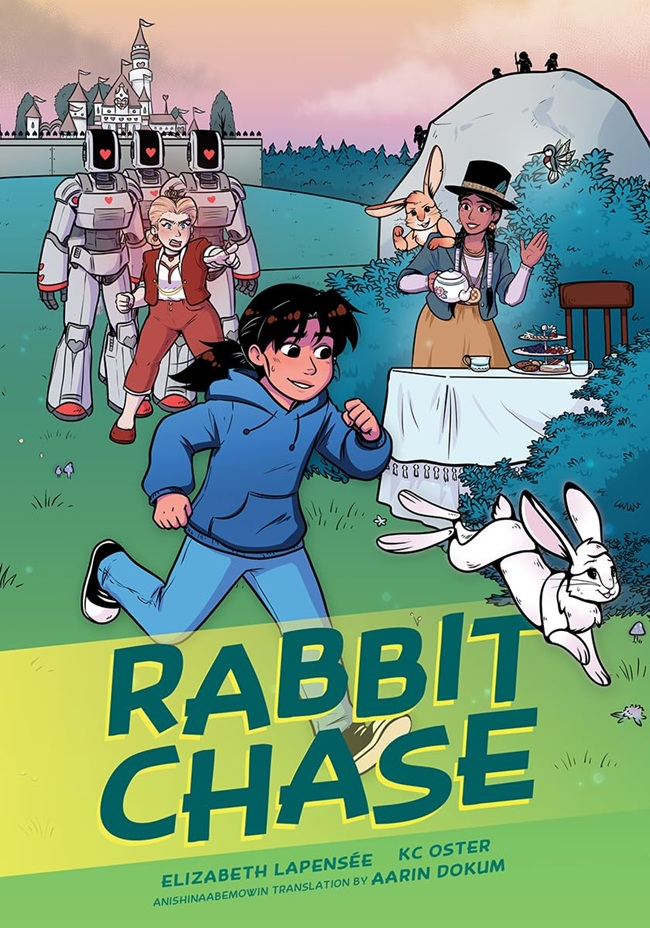
Rabbit Chase is a wonderfully illustrated graphic novel for pre-teens. Loosely based on Alice in Wonderland, it follows Aimée’s adventure during a school field trip. While visiting petroglyphs, Aimée, who is more interested in a video game on their phone, becomes separated from the rest of the group. They meet up with Jiibayaabooz (the white rabbit), who offers them a quest that will help Aimée get home. The quest is fairly straightforward in that Aimée needs to ask the Paayehnsag (Little People) to help Jiibayaabooz defeat some waterspirits. Throughout the quest, Aimée thinks about the times at school when Zhaagnaashag children were harassing them for being Indigenous and identifying as they/them.
One specific incident took place after a class about Columbus discovering America, something that Aimée contested and the white kids accepted as their ‘truth’. During the quest, Aimée encounters a tea party, where they are offered coffee, maple syrup, and blueberries, and converses with Nanaboozhoo (depicted as a brown rabbit), Auntie, and a hummingbird. During the conversation, Aimée learns of a Queen who has been coveting, collecting, and destroying the land while planting flowers to mark her territory. Obviously, this is a lovely reference to the various treaties signed with the Crown and the introduction of invasive or non-native plants that often marked the extent of European expansion. Aimée eventually meets the Queen, defeats her in a game of laser-tag, and narrowly escapes losing their head. Eventually, with the help of the flower people, Aimée meets the Paayehnsag and accepts a copper token as a gift from them. The waterspirits are engaged and defeated, thereby enabling Aimée to return home. They are surprised when re-entering their world as Aimée reappears at the point of their separation from the class, and their ‘absence’ went unnoticed by classmates. It ends with Aimée beginning to make friends over a shared culture and experiences.
Aimée, the main character, harassed at school, feeling socially isolated, often escapes into her video games. The adventure with the white rabbit and little people, while defeating the Queen, thereby preventing further land loss, allows Aimée to grow as a person, accepting who they are, finding pride in their culture, and stepping out to engage with others. At its heart, the story is about accepting yourself, helping others, and personal growth, all through the experience of Anishinaabe culture. It is culture that helps shape Aimée. Importantly, the graphic novel also offers words and terms in Anishinaabemowin to encourage linguistic growth and knowledge. I appreciate how language use is tied to culture and personal growth; this effectively illustrates that cultural and linguistic knowledge are closely linked.
As an Alice in Wonderland adaptation, Rabbit Chase is both serious and humourous just like its inspiration. I love how Aimée destroys Auntie’s house by growing too big, Nanaboozhoo’s excuse for never settling down – ‘I never found the right woman,’ as well as the not-so-subtle references to the Crown, colonization, and environmental destruction. The bright, colourful illustrations bring the text to life. Differing colours convey the emotions and situations Aimée finds themselves in, while drawing the reader’s eye to the story these convey. The text and illustrations are simply a wonderful way to convey the story and its lessons.
I heartily recommend this graphic novel for pre-teens. It will appeal to their sense of humour, present the familiar, while teaching culture, language, and the importance of self. It deals with racism and self-doubt, and demonstrates how these can be overcome, or at least mitigated, through pride in culture, language, friends, and self-awareness. Overall, it is an excellent graphic novel and thoroughly enjoyable. Finally, the author is donating their royalties to the protection and recognition of the Sanilac petroglyphs. It is a great read and a wonderful gift.
Elizabeth LaPensée and K. C. Oster, with Anishinaabemowin Translation by Aarin Dukum, Rabbit Chase. Toronto: Annick Press, 2022.
ISBN 1773216201