

TEK Elders hold demonstration against Glyphosate spraying
August 27, 2025
By Leslie Knibbs
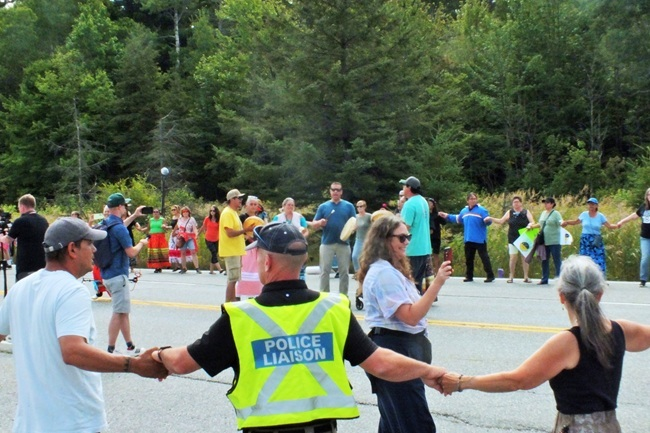
SERPENT RIVER FIRST NATION – The Traditional Ecological Knowledge (TEK) group held a two-hour direct-action protest rally against the spraying of glyphosate in area forests on August 14. During the two-hour rally, several people took part in a Round Dance, stopping the traffic on the Trans-Canada Highway. The protest was held between 10 am and noon at the Serpent River First Nation (SRFN) Trading Post on Highway 17 and was the latest effort in the TEK’s continuing campaign to stop aerial spraying. The scheduled spraying of glyphosate includes Sudbury, Temagami, Dryden, Spanish, Pineland, Trout Lake, Lac Seul, Gordon Cosens, Abitibi, and Nipissing forests.
The TEK group is made up mainly of Elders from Garden River First Nation, Sagamok First Nation, Thessalon First Nation, Batchewana First Nation, as well as Mississauga #8 First Nation and Serpent River First Nation. Elder Caroline Recollet from Wahnapitae First Nation serves as the spokesperson for the Elders’ “Stop the Spray” Campaign. Recently, TEK released the following statement: “TEK rejects the Ontario Ministry of Natural Resources’ claims about the need for herbicide ‘management,’ and reminds us that TEK Elders founder Raymond Owl refers to aerial glyphosate use as ‘raining poison from the sky.’
“Ontario has an obligation to respect our Treaty rights,” said Elder Recollet. “When forests are converted to plantations, all life is affected – we share these lands with all creation.”
Chiefs of Ontario released a statement on July 31, informing the Ministry of Natural Resources (MNR) that all 40 First Nations have come to a consensus to reject glyphosate use in forestry across all First Nations’ lands. The Chiefs of Ontario have taken up the campaign on the TEK Elders’ behalf, and several Chiefs have been invited to join the action on August 14.
The Elders are long-standing opponents to the spraying of chemicals on the land and in forests. For more than a decade, TEK has been actively protesting and lobbying both the provincial and federal governments against aerial spraying. They have held numerous demonstrations on Parliament Hill in Ottawa, as well as Queen’s Park in Toronto. Indeed, what began with a small group of TEK Elders meeting together in Serpent River First Nation and Mississauga #8 First Nation over 10 years ago has manifested into a province-wide movement for change in the way forestry management is maintained.
TEK Elders have had little to no success in their struggle in convincing the governments to stop the spraying over the last decade; however, their persistence and dedication to the cause has exponentially brought awareness to the issue resulting in mounting concern by many municipalities, environmental groups, as well as other individuals, all aligning themselves with the TEK as allies with a sole purpose of putting a stop to aerial spraying. Their message has spread fast throughout Ontario, with many other First Nations holding their own rallies or protests.
Municipalities and their citizens across the province are offering support to stop the spraying. These include Moonbeam, Kirkland Lake, and Sudbury, among others, and they continue to email their MPPs calling for the immediate halt to aerial spraying of glyphosate. Sudbury leads the way in the number of emails sent to the province. Local MPP France Gélinas in the Nickel Belt has worked steadily advocating for the ban. Several groups, including Stop The Spray Ontario, have started petitions to present to the province.
Elder Joe Jones from Garden River First Nation has been a member of TEK since the group’s formation and has participated in many actions. According to Jones, TEK has been hammering away trying to get their message across to the government.
“They don’t listen,” he said recently.
The founders of TEK Raymond Owl from Sagamok First Nation and Willie Pine from Mississauga #8 First Nation have been out in the forest for many years at different times of the year, noting the dramatic changes in the wildlife when harvesting, as well as the many diverse trees in the mixed forests have, in some cases, been replaced by jack pine plantations as a result of using glyphosate-based herbicides. Healthy mixed and natural forests are increasingly becoming plantations for profit by the lumber industry. When confronted with this information, the MNR claims the herbicide is a necessity to “control competing vegetation.” According to the MRN and forestry groups using the herbicide, it (glyphosate) is necessary and helps “meet long-term wood supply needs.”
On August 19, Dr. Susan Bell Chiblow, a citizen of Garden River First Nation and professor at the University of Guelph, distributed a press release about a new project led by Indigenous and non-Indigenous scholars, Knowledge Keepers, and Elders to “transform how chemical risk is managed.” At the heart of Indigenous approaches to caring for the land, waters, air, and eachother, the project’s intent is to set out priorities, develop protocols, and prepare for the interdisciplinary collaborative work ahead. According to the press release, “The six-year-long initiative, ‘Towards Sustainable Futures: Transforming Chemical Risk Management with Indigenous Expertise’, sets out to profoundly transform chemical risk management in Indigenous community-based practices, university labs and classes, regulatory practices, and policy development.”
Nipissing First Nation (NFN) recently held a rally in front of MPP Vic Fedeli’s office opposing aerial spraying. NFN Gimaa (Chief) Cathy Stevens said in a recent interview that NFN, like all other First Nations, opposes the spraying of the forests in her area. This is not the first time NFN has dealt with the issue. At an earlier time, Hydro One was using aerial spraying to clear power line pathways; however, after NFN approached them requesting a halt to this method of controlling vegetation, Hydro One put a stop to the spraying and instead used manual clearing methods by hiring local NFN citizens to do the job.
“Aerial spraying years back put a directive to the MNR to stop the aerial spraying,” she explained. “Hydro One was very respectful, hiring members of our community to clear the underbrush…The concern that we have is that the community members that use the medicines.”
The spraying operation on the North Shore would result in 4,500 hectares being doused with the herbicide glyphosate, negatively affecting aquatic life, killing blueberries and other plants, as well as medicines and tree species common to a natural forest, effectively changing the natural landscape from a pristine forest to a plantation of easy-to-harvest spruce and pine trees for the lumber industry.
From an economic point of view, the Ontario forestry industry generated $21.6 billion in revenue, supported 42,500 direct jobs. The industry exports $7.95 billion in forestry products in 2024. In contrast, the neighbouring province of Quebec, which had completely banned the aerial spraying of glyphosate in its forests, exported $11.3 billion in forest products, employing 61,000 workers. Quebec’s forests make up 20 per cent of Canada’s forested area. Canada is the third largest country with forests, second only to China and Russia.
Despite NFN and others requesting a stop to the spraying of glyphosate in their forests, the MNR has started the province-wide annual spraying; however, the North Shore forests have been spared this year, with the MNR putting a stop to the aerial spraying this year only, according to their offices in Sault Ste Marie, Ont. There has been no press release announcing the halt to spraying or an explanation as to why it was stopped.
On Monday, August 25, days after the TEK demonstration and other protests on aerial spraying, Andrew Horahan, executive vice-president of Interfor (company contracted by MNR to do aerial spraying) confirmed in a statement, that there would be no aerial spraying this year in sections of Northern Ontario.
“For 2025, Interfor has chosen not to proceed with an herbicide application in the Pineland, Spanish, and Northshore forests.”