

Before freezers, the mooz was shared
By Marci Becking
SUDBURY – The 2nd annual Anishinabek Nation Mooz Maawanjiding (Moose Symposium) was held on September 3-4, in Sudbury, Ont., to create connections amongst mooz advocates and reconnect participants to their relationship with the moose.
Day one had many presentations, including Anishinaabe perspectives on harvesting, moose health, Mi’kmaq way of resource management, community-level research, and a tanning demonstration.
Knowledge Keeper Perry McLeod-Shabogesic from Nipissing First Nation spoke about what the moose can teach us.
“The Hoof Clan have been here long before us. The Mooz have taught us about our family, about our relationship with the Creator. They continually remind us that we need to reconnect our relationship with relatives of creation. We are in a special time. The Hoof Clan begins their life cycle again. The Hoof Clan teaches about kindness, strength, and the gentleness of our words and actions. Teaches us to be heard and seen,” said McLeod-Shabogesic.
He explained that as a hunter, he is still learning.
“My brothers are much skilled hunters than I am. I took a different view with the Mooz in that I wanted to learn our traditional relationship as brothers and sisters with the Hoof Clan. The more you learn, the more you don’t know. Some of the things about the Hoof Clan is from the stars. Old stories about origins of all the clans – the Hoof Clan being one of them. During the year, our mother moves – she rotates. When it is a starry night, you will see groupings of stars, and they seem to move in a counterclockwise way. We are seeing the constellation that looks like a Mooz running. Our grandmothers and grandfathers followed the stars to know when to harvest. The Mooz also teaches us about the collective and how it is as important as the individual.”
McLeod-Shabogesic also expressed that the introduction of freezers made people hoard.
“Before freezers, you brought in the Mooz and had to share. For us to sustain ourselves in our diet, we can’t just eat meat. We need to eat those other parts with traditional value.”
Dr. Brian Stevens, Wildlife Pathologist for the Canadian Wildlife Health Cooperative, spoke to participants about understanding moose health – the methods, insights, challenges, and climate realities.
Tamara Gover, Sr. Wildlife Policy Advisory, and Larissa Nituch, Science Operations Supervisor, both with the Ontario Ministry of Natural Resources, shared an online presentation discussing an overview of chronic wasting disease.
Clifford Paul, Moose Management Coordinator at Unama’ki Institute of Natural Resources, spoke about the Mi’Kmaq Way of Resource Management and Practicing Treaty Rights, the traditional aspect.
“He says that the management style comes from the grassroots people. When you work closely with government – not the top, but middle management – you create allies.”
Paul said it is a really good way for them to bring issues to the table.
“Management is an ongoing conversation with the communities.”
Curtis Avery, Environment Manager for Nipissing First Nation, did a presentation on What the Moose are Telling Us: Community-level research at Nipissing First Nation.
“The strategic plan guides your stewardship and protection of natural resources,” said Avery. “In Nipissing First Nation, the objective is to promote safe and responsible harvesting of animals of the land and water.”
He explained that the Environmental Management Plan will be brought to the community for consultation.
“We’re going to try to do land-based camps and education opportunities for youth. We will also monitor the species that there isn’t much data on.”
He said that it’s important to document the nation’s use and occupancy of Indigenous research, as there are no standards for Indigenous research, and it is often biased, and the government uses it to their advantage.
“When First Nations do win the courts, the information is withheld as to how they did that,” explained Avery.
Anishinabek Nation Lake Huron Regional Chief Scott McLeod said that the ministry will not just give up any jurisdiction.
“[The ministry’s] hand must be forced to co-manage anything, even though we [have] the inherent right to fish commercially. When [Nipissing First Nation] started creating our own [fisheries] law, they lost their jurisdiction of us in the courts.”
Terra Roy from Beausoleil First Nation is a member of the Anishinabek Nation Eshki-niigijig Advisory Council and did a demonstration on how to make a soy-based hide tanning mixture that is a brain-alternative. Roy’s soy-based hide tanning mixture consists of four cups of water, shredded Sunlight bar soap, and soybean byproduct (like a cheese curd).
“Because of climate change, we’ve had to do things two or three weeks sooner,” she explained. “We stopped doing hide camps in August in central/southern Ontario. We lost a lot of brains because we couldn’t get to them in time.”
“There is enough brain in a moose to have enough to tan a moose hide,” she said. “Every animal has enough in its brain to tan its hide. It can be a different animal – you can use pork brains.”
She noted that brains do not smell very nice, which is why the alternative that she was demonstrating was a good option.
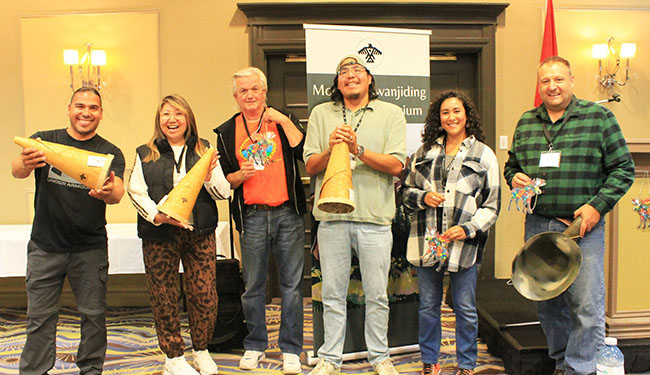
Day one of the symposium also included the popular Mooz Call Competition. Winners were: first place – Shannon Gonawabi of Atikameksheng Anishnawbek; second place -Niibin Giizhigo Kwe of Wiikwemkoong Unceded Territory/Atikameksheng Anishinawbek; and third place was Trudeau-Zachariah of Wiikwemkoong Uneceded Territory/Atikameksheng Anishnawbek.