

E-niigaanwidood E’Dbendaagzijig Corbiere Lavell advocates sovereign right to decide citizenship and One-Parent Rule
By Mary Laronde
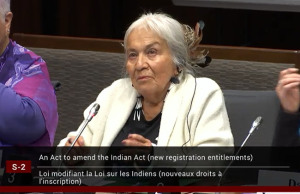
OTTAWA— Anishinabek Nation E-niigaanwidood E’Dbendaagzijig (Citizenship Commissioner) Jeannette Corbiere Lavell addressed the Standing Senate Committee on Indigenous Peoples on Oct. 21, in Ottawa, Ont., to speak on the Government of Canada’s Bill S-2, An Act to amend the Indian Act (new registration entitlements).
While Bill S-2 addresses some outstanding issues surrounding enfranchisement, it fails in the area of recognizing First Nation autonomy in determining citizenship without government interference; however, the One-Parent Rule adopted by the Anishinabek Nation and recognition of Anishinabek inherent rights to decide citizenship would address those shortcomings.
“In my Nation, we follow a one-parent rule. We know who our people are — E’Debendaagzijig, ‘Those who belong.’ Recognizing First Nations’ inherent jurisdiction to decide who belongs, eliminating the second-generation cut-off, and following a one-parent rule is the way for the Government of Canada to right its wrongs. This is the only way to stop the forced assimilation that continues today under the second-generation cut-off. We must not lose more of our people!”
Commissioner Corbiere Lavell said that Canada has our answer.
“As Commissioner for the Anishinabek Nation, I advocate for E’Dbendaagzijig,” states Commissioner Corbiere Lavell. “In February 2025, we adopted the Anishinabek Nation Declaration on E’Dbendaagzijig, which expresses the foundation of our jurisdiction and First Nations citizenship laws.”
The Declaration on E’Dbendaagzijig states that only Anishinabek First Nations have the right to decide who belongs within their communities, and that the Government of Canada has an obligation to recognize and support inherent, Aboriginal, and treaty rights by recognizing First Nation rights. This will require land and financial resources to support recognizing their citizens.
Commissioner Corbiere Lavell also pointed out that “Canada will not recognize our people and our rights, yet it will recognize self-identifying groups with no Aboriginal title and treaty rights and even fund them.”
The panel of witnesses included Commissioner Cobiere Lavell, Sharon McIvor, lawyer and First Nation women’s rights activist, and Dawn Lavell-Harvard, Director of First Nations House, Trent University, all of which called for the Senate Committee to amend Bill S-2 and to end all sex- and race-based discrimination from the Indian Act and to end the second-generation cut-off.
Bill S-2 responds to the constitutional challenge brought forward in Nicholas v. Canada (Attorney General), which relates to First Nations people who were the wives or children of men who were enfranchised (lost Indian status). Bill S-2 would restore status to this group; however, it leaves in place a larger discriminatory status provision – the second-generation cut-off.
The second-generation cut-off provides that after two generations of out-parenting (parenting with a person who is not registered as an Indian), the descendants cannot be registered as Indians. First Nations citizens registered under section 6(1) (full status) can pass on their Indian status, but those registered under section 6(2) (half status) cannot transmit status in their own right. Due to decades of historical sex and race discrimination, this cut-off impacts First Nation women and their descendants sooner, and more harshly, than the descendants of First Nation men.
McIvor and Commissioner Corbiere Lavell have been fighting against sex discrimination in the Indian Act for over 50 years. They support the registration of the Nicholas families, but also call on Senators to amend Bill S-2 to remove the second-generation cut-off so that neither the Nicholas plaintiffs nor any other First Nation family will be excluded from status.
The consequences of failing to amend Bill S-2 are dire. According to demographic predictions provided by Indigenous Services Canada (ISC), approximately 29 per cent of registered Indians have only half status [6(2) status], and, in some regions, rates can be as high as 50 per cent. Given the known rates of out-parenting, predictions show that in a matter of three to four generations, this policy will cause the legislated extinction of many First Nations; however, this rule is also ending family lines presently. Many children and grandchildren of First Nation people are already excluded from recognition, which impacts their treaty and other constitutionally protected rights.
Many of the witnesses to date have called for amendments to Bill S-2 to eliminate this genocidal policy meant to “get rid of the Indian problem”. The federal government has responded by suggesting yet another study of the issue, despite the fact that reports from their previous studies and consultations in 1990, 2011, and 2019 all found that the second-generation cut-off was the issue of biggest concern to First Nations and calls for its elimination have been made repeatedly. Yet, despite these studies, no legislative action has been taken to remedy the discrimination.
Sharon McIvor explained that since 1985, she has interacted with 18 different Ministers of Indian Affairs/Aboriginal Affairs/Crown-Indigenous Relations/Indigenous Services Canada.
“They have said, ‘Trust us. Accept this incremental change now, and we will fix the rest later.’ Here we are again in 2025, the Act is not fixed, and it is long past time for Canada to stand with First Nations women and their communities, to remove the second-generation cut-off right now,” stated McIvor.
The journey for advocating for First Nations women’s rights has been long, but Commissioner Corbiere Lavell remains hopeful.
“Since 1971, I have been fighting for my rights as a First Nation woman, and the rights of my children and grandchildren. I hope this is the last time we have to ask Canada to correct its sexist and assimilationist law.”