

First Nations leaders address provincial legislation at ANEDO 2025 forum
By Sam Laskaris
CHIPPEWAS OF RAMA FIRST NATION – Anishinabek Nation Lake Huron Regional Chief Scott McLeod was keen to make an emphatic point.
“I just want to make it perfectly clear,” Regional Chief McLeod said during the Leadership Panel session, which was held on Day 1 of the Anishinabek Nation Economic Development Opportunities (ANEDO) Forum on Oct. 16 in Chippewas of Rama First Nation. “Bill 5 does not create any new opportunities. The opportunities in our territories have always been there. Bill 5 looks to shortcut their access to those opportunities.”
Regional Chief McLeod was speaking about the provincial bill, which was passed this past June and is officially titled Bill 5, Protect Ontario by Unleashing our Economy Act, 2025.
The bill is aimed at streamlining regulations for major infrastructure, mining, and resource projects in the province.
“The opportunities exist because of our land, because of the territory that we have occupied since time immemorial,” he added. “Bill 5 is smoke and mirrors. It’s a way to access those lands with as little resistance from us and from our friends – non-Indigenous friends – who care about the environment, looking to shortcut past all those checks and balances that protect these lands.”
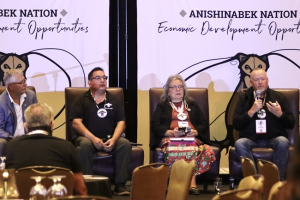
Regional McLeod was joined on the panel by Anishinabek Nation Deputy Grand Council Chief Chris Plain, and Southeast Regional Chief Marsha Smoke. Former Anishinabek Nation Grand Council Chief John Beaucage moderated the panel.
Deputy Grand Council Chief Plain said reaction to the provincial legislation is varied.
“A lot of communities are undertaking economic development initiatives,” he said. “Some see it as an opportunity, but many communities see it is as a challenge to our rights.”
Deputy Grand Council Chief Plain said some First Nations are trying to make the best of the situation.
“Some will look forward to some opportunities,” he said. “But I guess my perspective, many of the Chiefs are concerned over-all with the processes that we’ve been accustomed to.”
He said there was no First Nations consultation, participation, or community buy-in offered before Ontario’s Conservative majority government pushed through its bill into law.
Regional Chief Smoke also spoke disapprovingly of Bill 5.
“On paper, it’s meant to speed up approvals and attract investment,” she said. “In practice, it shifts power to ministers to exempt projects from environmental, heritage, and local planning laws.”
Regional Chief Smoke added that while some First Nation members could benefit from the opportunities, the bill poses risks since it does not include First Nation consent or oversight.
“As Southeast Regional Chief, I see Bill 5 as a call for vigilance,” she said. “We must insist that any project under this legislation be First Nation-driven, with a clear consent, co-governance, and enforceable community benefits. Otherwise, it could only open the door for development that happens to us instead of with us.”
Because of the way the bill transpired, Regional Chief McLeod believes it will be challenging for any First Nation to work with government officials on any proposed initiatives.
“We’ve been fighting for recognition of the treaty since the ink dried on the treaty,” he said. “And so, it makes it difficult for us to participate at any level with major projects in our territories when this is overlooked… They create legislation on top of what we’ve already been fighting for and that really buries our treaty even further under their legislation and bureaucratic policies for us to sit at a table as equals.”
It’s a story Regional Chief McLeod has seen before.
“In our territories, when these projects come, proper consultation is not achieved,” he said. “It’s after the fact. And we end up either fighting government or we end up on the streets or we end up in courts to try and get what justification we can through their colonial system, which is very difficult for our communities.”
Regional Chief McLeod believes that government officials may be hurting themselves in their haste to fast-track projects.
“What they don’t realize is that they’re only going to slow down the development because First Nations are not going to provide consent on these projects until they fully understand it,” he said.
Regional Chief Smoke is unsure if it’s possible to make any changes to Bill 5, but she added that any upcoming projects must include First Nations consultation and believes nation-to-nation dialogue and planning are also required.
“And that means early involvement in any of the projects that are coming forward and the ones that may be moving forward by our own First Nations,” she said. “We have to continue to push governments to recognize that First Nations, we have our own laws. We have our own land-based plans and protocols, and that those can be used to decide any major projects coming forward.”