

Garden River Anishinaabekwe recognized by the Royal Society of Canada
By Rick Garrick
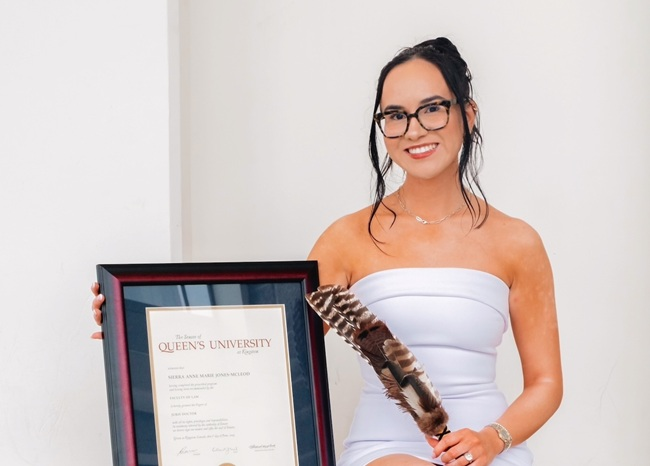
BELLEVILLE — Garden River’s Sierra Jones-McLeod, a Queen’s University Faculty of Law graduate, was recently recognized with a Justice Rosalie Silberman Abella Prize by the Royal Society of Canada. The Justice Rosalie Silberman Abella Prize is presented annually to a graduating law student from each of the 24 law schools in Canada who is most likely to positively influence equity and social justice in Canada or globally upon graduation.
“It’s been incredible to receive the recognition that I’ve gotten through this award,” says Jones-McLeod, who is currently articling with Legal Aid Ontario in Belleville and Napanee. “Throughout my time in law school and throughout my time in my career thus far, I’ve always just wanted to make an impact and wanted to really reshape the community of law altogether to make it a more inclusive field for Indigenous people.”
Jones-McLeod, who served as a co-chair of the Indigenous Law Students ’Alliance at Queen’s, is deeply committed to social justice through criminal defence with a focus on addressing the over-incarceration of Indigenous people in Canada.
“I’m an articling student for 10 months to get my requirements fulfilled before becoming a lawyer and I’m currently doing that at Legal Aid Ontario in Belleville and Napanee in their criminal and family departments,” Jones-McLeod says. “It’s really great, it’s such a good opportunity for me to connect with people who are like me and come from a very similar background, especially in Belleville being so close to Tyendinaga.”
Jones-McLeod appreciates being able to give back to the Indigenous community through her role with Legal Aid Ontario.
“Maybe I’m not close to home at this time, [but] I’m still able to create an impact on Indigenous communities,” Jones-McLeod says. “In Belleville, specifically, we have an Indigenous Peoples’ Court, also known as a Gladue Court, that I’ve been involved in and been shadowing the duty counsel lawyers in, so I think that has been a really interesting aspect within my articling so far, that I’ve been able to put my own perspective on things and really just engage with my culture throughout my career thus far.”
Jones-McLeod says she is preparing to do the bar exam in November.
“We have to read both the barrister and the solicitor materials and then take a lot of practice exams,” Jones-McLeod says. “It’s really just a lot of reading. It’s a pretty difficult process, especially for Indigenous people. For me, I learn different than a lot of other people.”
Jones-McLeod says she first graduated with a Bachelor of Arts Honours degree in Global Development Studies at Queen’s before studying law.
“The most meaningful experience that I did have was at the Queen’s Prison Law Clinic,” Jones-McLeod says. “During that time, I really advocated for a lot of incarcerated individuals of different backgrounds. I got the opportunity to run two parole hearings during that time, one that was out of Collins Bay and one that was out of Bath Institution.”
Jones-McLeod also participated as a student caseworker with the Advanced Prison Law Clinic during her third year in law school.
“We ended up doing a lot more of federal human rights complaints and grievances and parole hearings, and throughout that time, I specifically assisted with Indigenous incarcerated individuals,” Jones-McLeod says. “I really was able to make great relationships with these people and really get to learn why a lot of Indigenous people are affected by the criminal justice system, the way that they are due to intergenerational trauma or the Sixties Scoop, different colonial events that have really shaped the way that our people live and our people have experienced the criminal justice system.”
Information about the 2025 Justice Rosalie Silberman Abella Prize recipients, who will be honoured during the Awards Ceremony on Nov. 14, is posted online.