

Madahbee Leach encourages First Nation leaders to connect on economic development initiatives
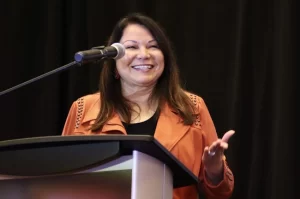
By Sam Laskaris
CHIPPEWAS OF RAMA FIRST NATION – There’s no denying First Nations businesses have an increasing amount of opportunities these days; however, Dawn Madahbee Leach, the general manager of Waubetek Business Development Corporation, a leading Indigenous financial institution, believes it is best to approach those opportunities with plenty of caution.
Madahbee Leach was a panelist at a session held at the 3rd Annual Anishinabek Nation Economic Development Opportunities (ANEDO) Forum.
The four-day event, which concluded Oct. 17, was held at the Casino Rama Resort in Chippewas of Rama First Nation.
Madahbee Leach, a member of Aundeck Omni Kaning First Nation on Manitoulin Island, spoke at a plenary named Capital and Community Growth: Innovation in Equity Financing.
“One of the areas that I’ve seen First Nations get into is where you are working directly with a company [that] will lend you the money to have that equity investment in the business,” Madahbee Leach said. “For example, it could be an energy company, and they’ll lend the First Nation the money. The problem is, when you’re going that route, you don’t have that funding for the expertise to help you assess that opportunity.”
She added that she’s worried that numerous companies are approaching First Nations, offering equity opportunities that sound too good. Madahbee Leach, however, believes First Nations require help to assess these opportunities. She noted that at times, companies are simply self-financing and by the time a loan is repaid, First Nations haven’t actually earned any revenues for their community.
“All of the money you have been making has been going back to paying for that equity loan that was provided to buy that company,” she said. “I really want you to have your eyes open on some of these. I really want you to not hesitate in seeking advice that you need from people who know that industry… It’s exciting to be part-owner of some of these big companies and these developments that are taking place. But at some point, you might want to look at a smaller equity portion.”
Madahbee Leach also encouraged leaders from First Nations to help each other by candidly discussing their initiatives.
“I think one of the ways that we can be bold is not to be shy when speaking to your fellow First Nations communities and sharing some of the information,” she said. “Maybe they will know other First Nations that are involved in a mining project or energy project.”
Madahbee Leach added that she doesn’t believe this happens often enough and that it would be beneficial for First Nations to learn from others about what not only worked but also what didn’t work.
“We learn from the failures, too,” she said. “I think that that’s a hard thing to do is to reach out and to talk to other First Nations communities.”
But she also said other First Nations are ideal parties to seek information from.
“They have the same interest,” she said. “They’re protecting their people and they’re protecting their lands, too. So, I think that it’s bold of us that we speak to others and don’t play our cards that close to our chests anymore. I think we need to work together on a lot of these things.”
The panel also included Stephen Scott and Jacky Papatens. Scott is the director of investments at the Canadian Infrastructure Bank, while Papatens is the member services manager of the First Nations Finance Authority (FNFA).
Scott said it is vital that First Nations know they are working with suitable partners on their initiatives.
“I think the most important lesson we’ve learned is making sure that the First Nation has the right partner along the way,” he said. “We do a lot of the work in terms of the project advisory, providing the loan agreement, special financing, flexible financing terms. But what really matters is that the Nation has really strong partners in their advisors, in their contractor, in their staff that are working on the actual project.”
Papatens provided updates on initiatives of the FNFA, which was launched after the First Nations Fiscal Management Act was passed in 2005.
“Everybody wants that access to capital,” Papatens said. “So, we’re constantly working with government, primarily to increase that access to capital.”