

Remembering and honouring Indian Residential School Survivors and the children who never returned home
By Rick Garrick
THUNDER BAY — Fort William First Nation Chief Michele Solomon stressed the importance of remembering Indian Residential School Survivors and the children who never returned home during Thunder Bay’s National Day for Truth and Reconciliation Survivors Flag Raising ceremony on Sept. 29.
“Raising the flag is a symbol and an acknowledgement of the National Day for Truth and Reconciliation,” Chief Solomon says. “That it is happening on the eve of that day is very important, it’s an opportunity for us to give pause and reflect on all of the things that have happened in our collective history to get to this point today.”
Chief Solomon says it was encouraging to see a diversity of people at the flag-raising ceremony at Hillcrest Park.
“We need our non-Indigenous [community members] to join us and develop relationship with us and grow and evolve with us — this is an opportunity for learning and understanding each other better,” she says. “I acknowledged that a non-Indigenous person speaking this evening spoke about the impact to him of learning more about this and understanding better. We know that there’s more of this information being shared in the schools with our children, so it’s impossible for things to look the same in 30 years from now because the young people who are going to school now, will have the benefit of that true education, the true history of what happened in relationship with each other over these last 500 years.”
Chief Solomon says she has family members who experienced the Indian Residential School System, including her mother who experienced Day School.
“And the education, actually, I can’t even for the most part call it education, the training that our people went through in these institutions, it was harsh in Day Schools, and we know that children didn’t make it home to their families,” Chief Solomon says. “To me, I can’t even imagine what it is like to send my child to school and have them not come home. I’ve had a child die, so I know the loss of a child. So on a personal level, I can resonate that feeling of loss, that feeling of grief, that feeling of trauma, and knowing what my own loved ones have gone through in those systems is very tragic.”
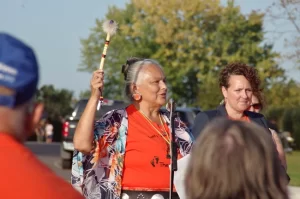
Fort William Elder Sheila DeCorte, who delivered an opening prayer to begin the Flag Raising ceremony, says her Talking Stick is her demonstration of resiliency.
“It’s made out of diamond willow, and for me, it demonstrates our resilience as Anishinaabe people,” Elder DeCorte says. “Diamond willow, when it’s attacked by any kind of infestation, it isolates it, and then it can’t move up the entire tree. It carries its scars on the outside, that’s its demonstration of resiliency. So no matter what was done to this tree, it still turns into something very beautiful, like my Talking Stick.”
Elder DeCorte says First Nations people carry their scars on the inside.
“You may not be able to see them, but that doesn’t mean they’re not there,” she says. “But we can still rise above that and become very strong and beautiful on the outside through the connection to Mother Earth, to the water, to all of creation, (and) most importantly, taking back what was taken away from us, the language, our culture, our sacred items, dancing at pow wows.”
Orville Councillor, one of the drummers at the Flag Raising ceremony and a Naicatchewenin citizen from Treaty #3, says they sang a flag-raising song that originated in Wisconsin.
“It was an emotional time for all of us, and we were remembering the purpose of why we were doing this, and that’s the kids and everything that we’ve endured over the past 500 years,” Councillor says. “It was nice to see a diverse crowd here this year. It’s a good time to think about the purpose of why we bring out these drums. It brings out a very emotional song, which originated from Wisconsin. We did it with great emotion and I felt the spirit of our ancestors with us today.”
Fort William’s Nolan Schmerk says the Flag Raising ceremony was an emotional experience.
“I’m just finding myself regrouping after that beautiful song,” Schmerk says. “I was a little bit late in coming here, but I think my arrival was perfect as I’m watching the sun dip behind the horizon here and the flag go up. As a performer, I want to make a difference and help give back to this community and in some kind of way, shape, or form, figure out how to make hip-hop the movement and a place, and that’s why I’m here praying right now and put down my tobacco and hope those doors open up because we just need alternative spaces.”