

St. Joseph’s Care Group supporting hospitals and community organizations to embed Indigenous perspectives into care
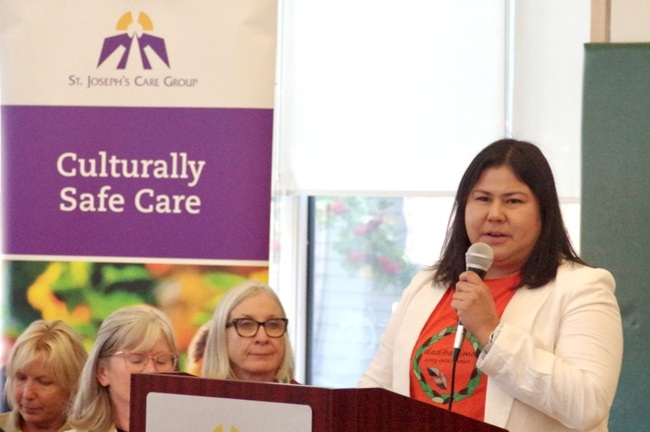
By Rick Garrick
THUNDER BAY — St. Joseph’s Care Group held a Sacred Fire, which included the release of the Wiidosem Dabasendizowin Walking With Humility: Embracing the Teachings of the West Progress Report, on Sept. 23-26 at the Sister Margaret Smith Centre in Thunder Bay. The progress report is posted online.
“This is an important time for us, not just one month out of every year but to ground ourselves every day about the work that we provide at (St. Joseph’s) Care Group and integrating Indigenous knowledges, our cultures in the care that we provide, and being more inclusive,” says Regina Mandamin, a member of the St. Joseph’s Care Group Board of Directors and a Wiikwemkoong citizen. “[It’s] also a time for learning for people who come through these doors, but also people who are working here as well, so it’s a really great way to close out this four-day Sacred Fire.”
Mandamin says St. Joseph’s Care Group is leading the way by making the teachings available and enabling people to practice their culture and protocols in a safe way.
“It’s really important to have that access to ceremony on a person’s care journey, so I think that’s what’s really unique and really special about the work that the team is doing here,” Mandamin says.
St. Joseph’s Care Group had previously released the Wiidosem Dabasendizowin: Walking With Humility A Plan to Develop Relationships and Practices with Indigenous Peoples in 2018 and the Wiidosem Dabasendizowin Walking With Humility: Looking to the Southern Direction in 2022.
The Wiidosem Dabasendizowin Walking With Humility: Embracing the Teachings of the West Progress Report included an introduction of St. Joseph’s Care Group’s first regional director of Indigenous partnerships, Sarah Wright.
“Our work extends across northwestern Ontario, supporting hospitals and community organizations to embed Indigenous perspectives, cultural safety, and reconciliation into every level of care,” Wright says. “We are listening, learning, and walking alongside communities to ensure Indigenous voices guide the future of health services.”
Paul Francis Jr., vice president, N’doo’owe Binesi at St. Joseph’s Care Group and a Wiikwemkoong citizen, says this was their fifth year of hosting the four-day Sacred Fire.
“The first year was after the discovery of the 215 [at the former Kamloops Indian Residential School], so our [Ogichidaa Onaakonigewin] Elder’s Council guided us to start this,” Francis says. “After last year, they wanted us to commit to another four years. We started on Tuesday with a Sunrise Ceremony and the lighting of the Sacred Fire, which will burn until Friday.”
Francis says the Sacred Fire included a teaching lodge, which featured teachings about the Creation Story and about Anishinaabe people and their values, worldview, and cultural understanding; a tipi, which featured one-on-one sessions with Elders; and sweat lodge ceremonies.
“We just want to create this space where people can come and listen, where our people can share whatever they want to share about their own healing journey, and for non-[Indigenous] people to really listen and understand,” Francis says. “And we have the actual Sacred Fire where people are just visiting informally and those one-to-one conversations are happening.”
Janine Black, president and CEO at St. Joseph’s Care Group, says the Sacred Fire was a beautiful four days of ceremony.
“It ended with a lot of excellent feedback about the fire itself and also some of the progress on our Walking with Humility efforts,” Black says. “The amount of ceremony this year has been amazing and I can hear from our Elder Ernie Kwandibens how meaningful that ceremony was.”
Kwandibens, a member of the Ogichidaa Onaakonigewin Elder’s Council at St. Joseph’s Care Group and a Whitesand citizen, says they were pretty busy during the Sacred Fire.
“We are trying to bring back something the youth are looking for, and that’s that sense of direction that may be missing in their lives,” Kwandibens says. “And we are trying to reawaken the old ceremonies that our families and our tribe used to do many years ago.”
Kwandibens says people were looking for a sense of where they belong, noting that they are trying to reestablish that at the Sacred Fire and other gatherings they had in the past.
“It’s important to get that back and firmly entrenched back into our Anishinaabe way of life,” Kwandibens says. “It’s been mentioned to me by most of the Elders that I talk to that this could be the reason why there is so much turmoil in the youth’s lives, that includes the drugs and alcohol and the suicides that are taking place, because they don’t know where they belong.”