

Exploring the importance of harm reduction
By Rick Garrick
THUNDER BAY — Pays Plat First Nation’s Dr. Chris Mushquash and Long Lake #58’s Clarence Fisher were among the presenters and panellists at the Thunder Bay District Health Unit’s Harm Reduction Conference, held Nov. 13 at the Superior Inn in Thunder Bay.
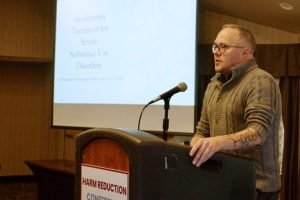
Dr. Mushquash, Canada Research Chair in Indigenous Mental Health and Addiction, professor in the department of psychology at Lakehead University, and clinical psychologist at Dilico Anishinabek Family Care, began the conference with his opening keynote on Involuntary Treatment of Severe Substance Use Disorders.
“I want to echo what our Elder Garry (Gustafson) said about all the gratitude we have for people that work on the front lines, it can be tremendously difficult work and we often do it at the expense of our own wellness at times, but it’s essential work,” Dr. Mushquash says. “In terms of practical tools, I want to start off with a bit of a practical tool — what we call things matters. And it matters not just to people, it matters to us as workers in the field, it matters to decision-makers, it matters to the public, and so on. So, we have to be very careful and think through those things and not allow the politicalization of those types of efforts to derail the good work that we are trying to undertake.”
Dr. Mushquash says it has probably been the experience of people in Thunder Bay to see others honking horns at or ridiculing people who are walking across the street who are quite distressed and appear to be under the influence of perhaps a substance or alcohol.
“All of us here know, if we’ve spent any time working with people who may have found themselves in that position at some point, these aren’t people that are worthy of ridicule, they’re not people who need car horns honked at them,” he says. “If you listen to them and hear their stories, my experience is that we often hear stories of tremendous amounts of trauma, we often have the experience of sitting with ultimately very good people, very kind people, and thoughtful people who have found themselves in a level of difficulty that is unimaginable to anyone else.”
Fisher, program manager of Nishnawbe Aski Nation’s Men’s Healing Initiative, participated in the Parents Like Us Panel Discussion along with Thora Cartlidge, Stephanie Diebolt, and Ronda Mackie. They had been involved with the development of Parents Like Us: An Unofficial Guide to Caring for a Young Person Who Uses Substances, a handbook aimed at helping parents and caregivers in similar circumstances find connection, compassion, and support in the community and is available through the Thunder Bay District Health Unit and for download.
“I have to concur with my colleagues up here that lived experience is important when we are creating a resource for people who are experiencing these things,” says Fisher, noting that many parents or caregivers may feel like they’re alone. “The stigmas around drug use and even being the parent of somebody who uses drugs is something we identified with, but what’s very important for all of us here and even as an Anishinaabe man is community. Community is important because we all have something to offer and specifically in this room, we’re all part of a community here.”
Fisher says he had spoken with an Elder because he had been discouraged, noting he had seen some deaths and tragic times.
“But he told me, [which] really hit home, was how much worse would it be without people like you,” Fisher says.
The handbook was adapted from the original Parents Like Us handbook written by parents in Victoria, B.C. Shaped by focus groups, storytelling, youth input, and art sessions, the handbook reflects local experiences — including voices from Indigenous caregivers and youth.