

First Nations entrepreneur looking to also assist fellow business owners
By Sam Laskaris
TORONTO – Chelsee Pettit has some rather lofty goals.
Besides yearning to accomplish some of those goals for herself, Pettit, an entrepreneur from Aamjiwnaang First Nation in southwestern Ontario, is also hoping to help other Indigenous business owners shoot for the stars as well.
Pettit founded her company aaniin Retail Inc., which sells various Indigenous products, in 2021.
The Ojibwe word Aaniin translates to ‘Hello’ in English.
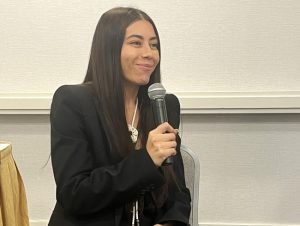
Pettit, who is considered a leading voice in First Nations economic reclamation, was also a speaker at the Indigenomics Bay Street conference held Nov. 7 at Toronto’s Chelsea Hotel.
She spoke at a conference breakout session titled, The Rise of Indigenous Entrepreneurship.
Though her business began exclusively as an online store, Pettit now operates pop-up stores at malls across the country, including, for the second year in a row, one at Toronto’s Eaton Centre, which opened in early November.
Last year, her pop-up venture at the famed Toronto mall did $550,000 in sales in four weeks. Pettit had worked various retail positions before making a go of it with her own company.
“I only felt comfortable enough to do that because I’ve been making millions of dollars in malls for the last 15 years of my life,” she said. “And I felt like I could put it to good work in my own business.”
Pettit told conference attendees she had gone to school for fashion design but dropped out. By the time she was 20, she was $70,000 in debt.
But through hard work that led to managerial retail roles, she was out of debt by the time she was 24.
“I’m very disciplined with money after I obviously learned through my mistakes and figured out what financial responsibility is,” she said. “People always talk about financial literacy, which is great. It’s important to know what money is, but I think it’s more important to hold yourself accountable behind that money.”
Pettit also recently launched a new business called Growth Cohort, where she teaches marketplace vendors how to scale up. She said the goal is to take vendors from markets to millions.
“I’m really good at building systems,” she said. “I’m really good at just seeing the path. Somebody can tell me the issue and I can have 22 different ways to fix it in less than three minutes.”
Pettit added she’s providing details on how others can make their businesses more appealing.
“I’m teaching the brands how to actually be profitable enough to enter those spaces and become a mainstream competitor, to compete on those shelves,” she said.
Pettit also said Indigenous businesses need to be careful with whom they deal. She said when large retailers approach these companies, they have to know exactly what they are getting into.
“It sounds like a pretty sweet deal, but you don’t actually know anything about what that costs,” she said. “You don’t know anything about it.”
To this end, Pettit said she’ll soon launch yet another company, a corporate advisory business to help guide others.
Pettit was also asked her thoughts on how to remove the colonial barriers of entrepreneurship.
“There’s not always a perfect way to get what you need,” she said. “It’s more about what you’re willing to take on yourself and what you think you’re capable of. For me, I’ve done the impossible already with no money.”
She said she’s talked to venture capital funders and spoken to virtually all of the Indigenous financial institutions.
“I’ve already done everything that people are telling me should be available,” she said. “But it’s actually not accessible.”
Thus, she’s taken a different approach.
“You have to do it yourself and whatever you think you’re capable of doing, you just have to make sure you can afford the fallout,” she said. “So, I’ve detached from all of my third parties that could potentially hate me forever… At the same time, I have massive community support. Every time I open up a pop-up, I have over 50 vendors that are knocking my doors down to get in.”