

Political quarterly update: Fall 2025
Daagwaagin (Fall) is upon us, and we give thanks for the harvest season. As the daylight hours become less, we give thanks for the bountiful harvests, reflection on what was, and prepare for the colder weather ahead. It is in this season, we honour our Ancestors and veterans, share stories, and hold our fall ceremonies. As our Mother Earth begins her winter slumber, we also need to take the time to reflect on what was and what could be. It is the time to reflect upon all the goodness that has bestowed upon us as we begin to prepare for Booboon (Winter). Despite the perceived uncertainty from recent federal and provincial legislation, we will be ready to deal with anything that may come our way from either government. We will continue to advance our interests and be steadfast with one Anishinaabe voice in advancing our rights-based agenda for all Anishinabek.
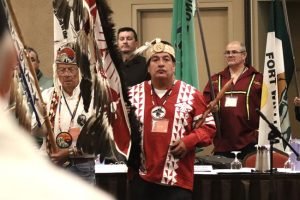
Our annual Fall Assembly recently took place in the Lake Huron Region in Sault Ste. Marie, Ontario, from November 3-5, 2025. The gathering had some very special moments within the Chiefs Circle. The Anishinabek Nation Head Getzit spoke about the power of these Circles and the sharing that needs to take place for our Gimaa Kweok miinwaa Gimaak (Chiefs).
Anishinabek Nation Leadership Council were honoured to have been welcomed to attend the various Remembrance Day celebrations held to honour the sacrifices of our Anishinabek Ogichidaak (Warriors) in past conflicts. These commemorative events were held across different Anishinabek Nation communities, emphasizing the significance of remembrance within our communities. The annual fall Chiefs of Ontario (COO) Assembly was recently held in Toronto and was crucial for sharing knowledge and setting agendas for the upcoming year. It gathered Chiefs and community representatives to discuss pressing issues such as education, child welfare, water, and infrastructure.
Other advocacy efforts included many unscheduled meetings with government officials, involving various stakeholders such as the Ontario Ministry of Indigenous Affairs and First Nations Reconciliation (IAFNER), Ontario Ministry of Natural Resources and Forestry (OMNRF), Ministry of Education, Ministry of Infrastructure, and different Anishinabek communities and leadership councils. They aimed to address pressing issues relevant to our Anishinabek communities, enhance intergovernmental relationships, strategize on leadership advocacy, and address various legislative reforms and initiatives. Since the recent federal election, we have observed a significant shift in our relationship with Indigenous Services Canada (ISC) and Crown-Indigenous Relations and Northern Affairs Canada. A new lack of engagement on the part of the Carney government seems to be what can be expected from this new Liberal government. We will need to double our efforts to ensure that the voices of our people are heard with this new Liberal government.
Our Anishinabek leadership have been very busy advocating for our people. Recently, we saw how the government introduced several new pieces of legislation, such as Bill S-2, An Act to amend the Indian Act (new registration entitlements), that would end the second-generation cut-off and implement the One-Parent Rule. The Anishinabek Nation adopted the E’Dbendaagzijig Naaknigewin, Anishinaabe law on “Those Who Belong,” which is grounded in gender equality and the One-Parent Rule, not the race-based, patriarchal rules embedded in the Indian Act.
Our continuing focus on unity within our Nation remains a top priority while continuing to advance Anishinabek Nation governance, Child Welfare Reform (FNCFS), and community well-being, with a recent focus on advocating for our member First Nations’ community safety and police services. Throughout our last round of Regional and Leadership Council meetings and strategic planning sessions, our focus remains on ensuring that we remain agile to respond to such things as Special Economic Zones Draft Regulations. Going forward, a Chiefs Strategic Framework Oversight Committee has been established to ensure an Implementation Response Strategy exists to provide political oversight, strategic direction, and accountability for the implementation of the Anishinabek Nation Strategic Action Framework for Bill 5, Protect Ontario by Unleashing Our Economy Act, and C-5, One Canadian Economy Act.
Grand Council Chief Debassige and Deputy Grand Council Chief Plain attended many events throughout the last few months, notably a full day spent with the Premier of Ontario where he announced a funding commitment for a new 64 bed long-term care facility in Wiikwemkoong Unceded Territory. Another event worth noting was the First Nations Energy Symposium 2025 held in Toronto, which featured a panel discussion focused on energy sustainability and development initiatives. The dialogues fostered a collaborative environment where participants could share insights on energy resource management, policy implications, investments, and community impacts.
Northern Superior Regional Chief Mel Hardy, Southeast Regional Chief Marsha Smoke, Lake Huron Regional Chief Scott McLeod, and Regional Chief Joe Miskokomon have also been incredibly busy, focussing their efforts on their respective communities and portfolios they hold and/or participate in at the Anishinabek Nation level and Chiefs of Ontario. Their contributions to the success of our collective advocacy and the support they provide to the Grand Council Chief and Deputy Grand Council Chief are unwavering.
The calendar of meetings from September 9, 2025, to November 26, 2025, shows our commitment to advocacy for our Anishinabek citizens and further strategic planning for sustainable community development. Our schedule does not contain the complete list of meetings and advocacy efforts on behalf of and directly for our Anishinabek Nation First Nations. As issues surrounding health transformation, environmental concerns, energy security, additions to reserve, and policing were brought to the forefront, ongoing dialogues and engagements within each region are set to foster further progress in these crucial areas. The responses and strategies developed during these meetings will pave the way for further advocacy on these communities’ priorities going forward.