

ReconciliACTION with the new Downie Wenjack Legacy Space at Canadore College
Trigger warning: readers may be triggered by the recount of Indian Residential Schools. To access a 24-hour National Crisis Line, call: 1-866-925-4419. Community Assistance Program (CAP) can be accessed for citizens of the Anishinabek Nation: 1-800-663-1142.
By Kelly Anne Smith
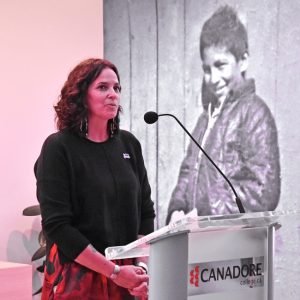
NORTH BAY – A large crowd attended the official opening of the Gord Downie & Chanie Wenjack Fund Legacy Space at Canadore College on November 12.
Well over 120 students, faculty, and community members heard Kevin Walsh from The Rodents perform songs from Gord Downie’s Secret Path album, followed by Canadore College’s Cultural Advisor Gerry McCoomb of Moose Cree First Nation opening with an Honour Song.
The late Gord Downie released Secret Path about Chanie Wenjack, a 12-year-old who was found beside a Canadian National Railway train track in 1966. Chanie died of hunger and cold when he was trying to escape the Cecilia Jeffrey Residential School in Kenora to get back to his home in Ogoki Post on Marten Falls First Nation, an over 600km trek.
Now the Downie & Wenjack Fund Legacy Space in Canadore College’s lobby is open and billed as a safe, welcoming place. Sarah Julian, the Director of the First Peoples’ Centre and Indigenous Engagement at Canadore College, says the Legacy Space is dedicated to truth, reconciliation, and learning together.
“I’m really excited to see the space come alive and excited to see all of the people here. I wasn’t expecting this many people, so it really warms my heart.”
Director of education with the Gord Downie and Chanie Wenjack Fund, Mair Greenfield, is a citizen of Kebaowek First Nation. She didn’t know about Indian Residential Schools until she was taught at Canadore College.
“I was raised in a non-Indigenous household, so I didn’t know about Residential Schools and then I learned in the classroom. The teacher primed the class and said, ‘We are going to learn about something very serious today. We are learning about Residential Schools. And if anyone laughs or if anyone says anything racist or rude, everyone in the class is going to get a zero.’ I was like, ‘What is she even talking about?’, because I had no idea,” recalls Greenfield. “Then she proceeded to tell us about Residential Schools and I think I went into shock. I couldn’t believe that actually happened. After class, I drove home and I went to talk to my mother because my mother worked with victims of crime. She worked with a lot of Residential School Survivors. We sat down and she said, ‘You know, I’m really sorry. It’s a really hard thing to share.'”
Greenfield explains that her aunties went to Indian Residential School on her father’s side.
“My grandfather didn’t go to Residential School. He actually ran away and he hid in the bush. But he did work on farms. There was also forced farming, which a lot of people don’t know about. I made it my own personal mission to share the stories and learn more and question why did that happen and what else happened. Residential Schools aren’t the only things that happened. There were the Indian hospitals and other unimaginable things that happened.”
Sarah Julian is Mi’kmaq on her mother’s side and her father is from Nipissing First Nation. Thinking of what Chanie and other children went through is upsetting, she says.
“We all know the story of the children being uncovered and the different kinds of experiences that the children had in Residential School. When I look at the picture of Chanie, it really hits home because you realize he was a young boy. As a mother myself who has children, it really hurts because his mom was waiting for him.”
Julian says that when the Legacy Space was being created, she reflected on her own journey of learning about Indian Residential Schools.
“As an Indigenous person, it’s very challenging and upsetting to know that you grow up without having those understandings of Residential School or Sixties Scoop,” she says. “It’s important that we continue to learn because there are still a lot of people that don’t know or don’t have that understanding. It’s that opportunity for people to continue to have those conversations… Even though it’s a difficult topic, it needs to be addressed and learned about. With that dialogue, the more we talk about it, the more we learn, the more we can build from it.”
Greenfield says there are approximately 80 Legacy Spaces in Canada, with Canadore’s being the most prominent.
“We have Legacy Schools. They’re available all throughout Canada. We work with educators and we send free tools. We send a copy of the Secret Path (graphic novel) that Gord Downie wrote. We send a TRC guide (Truth and Reconciliation Commission of Canada) so they have all the 94 Calls to Action. We send a flag. We send a calendar with significant dates for Indigenous days. We have a guide that we created so it helps folks understand the programs that we have. We work with Indigenous artists and we have an [Artist Ambassador] program. We bring artists into the classroom to work with students. We also create lesson plans for teachers to adapt to their own curriculum. We run a youth ambassador program for (ages) 16-25 and it’s open to Indigenous and non-Indigenous students across Canada. It’s a four-week program we run in the summer and when they are finished, they receive a $1,000 honourarium with their certificate of completion. They also work on a reconciliACTION, which is reconciliation but moving forward. It’s one thing to speak about reconciliation but it’s another thing to move it forward.”