

Book review: Gifts from the Thunder Beings: Indigenous Archery and European Firearms in the Northern Plains and Central Subarctic, 1670-1870
 Reviewed by Karl Hele
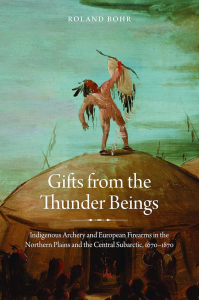
Gifts from the Thunder Beings: Indigenous Archery and European Firearms in the Northern Plains and Central Subarctic, 1670-1870 by Roland Bohr is an in-depth exploration of how Indigenous peoples in the Northern Plains and Central Subarctic utilized archery and firearms in hunting and combat.
Central to Bohr’s argument is the contestation of how the supposed superiority of European metal weapons, specifically firearms, resulted in the complete decline of Indigenous archery in both hunting and combat. Instead, throughout the work, Bohr shows that the reliance on firearms was dependent on time, circumstance, and the particular Indigenous group in question. Simply, the Blackfoot people recognized the utility of firearms in combat but continued to use the bow and arrow to hunt bison – archery was more efficient until the advent of cartridge ammunition, repeating rifles, and pistols. The Cree, however, rapidly and readily adopted firearms for big game hunting while relegating the bow to hunting small game and birds – firearms were more efficient in bringing down large game by an individual hunter. Regardless, both the Blackfoot and Cree peoples, as well as others, incorporated firearms into the cultural-spiritual-religious practices of their respective communities. Simply, “Different environments, subsistence activities, social organization, and economic pressures demanded different adaptive strategies and shaped Aboriginal peoples’ responses to European technologies. … [Aboriginal people] tried to achieve a functional balance by employing edged metal weapons and firearms together with Indigenous technology, so that these couple complement one another.”(316-317).
Gifts from the Thunder Beings: Indigenous Archery and European Firearms in the Northern Plains and Central Subarctic, 1670-1870 is divided into 11 chapters. The chapters explore the plains and subarctic environments, materials available to construct bows and arrows, divergent views on Indigenous archery technology, the types of firearms available for trade, injuries inflicted by arrows and firearms, cultural beliefs surrounding these weapons or tools and firearms, and how these technologies were utilized similarly and differently across Indigenous cultures. While every chapter was interesting and thought-provoking, it was chapters 7 to 10 that I really enjoyed. In Chapter 7, Bohr explores how archery and, eventually, firearms were situated within community and culture. By using artifacts in museums, documentary evidence, and Indigenous knowledge, Bohr tentatively links thunderbirds and Mishipihu to firearms, bows, and arrows. While Chapters 8 through 10 delve into how Aboriginal peoples utilized archery and firearms. For instance, the Blackfoot preferred to use the bow to hunt bison while making effective use of firearms as a weapon of combat. Apparently, the preference for mounted archery is tied to the early adoption of the horse and the ease of stringing and firing arrows from horseback. Whereas the Cree preferred muskets for hunting, which is posited on the solitary nature of the animals hunted and the report of firearms stressing animals in a given area, which makes bow hunting impossible. Finally, both the Blackfoot and Cree preferred firearms for warfare due to their psychological and physical impact, often delivered in a fuselage of fire for effect, followed by close combat. All in all, Chapters 7 through 10 were a fascinating exploration of how culture, environment, and belief influenced how archery and firearms were adopted, incorporated, and used.
Overall, Gifts from the Thunder Beings: Indigenous Archery and European Firearms in the Northern Plains and Central Subarctic, 1670-1870 is an informative text that offers a much-needed corrective concerning Indigenous adoption of European weapons technology and its multifaceted incorporation into our societies. It is a well-written monograph that is, for an academic text, a true page turner. I would recommend it to anyone interested in Indigenous hunting and warfare generally, to those interested in archery, as well as people seeking to learn more about the complexity of culture, contact, and material exchanges. This recommendation would also extend to anyone interested in learning more about the resiliency of Indigenous people. It is a very worthwhile read.
Roland Bohr, Gifts from the Thunder Beings: Indigenous Archery and European Firearms in the Northern Plains and Central Subarctic, 1670-1870. Lincoln: University of Nebraska Press, 2014.
ISBN: 978-0803248380