

Building stronger Indigenous-owned and operated businesses together
By Rick Garrick
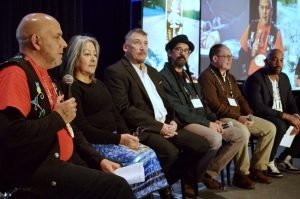
THUNDER BAY — A group of Anishinabek presenters and panellists recently highlighted their initiatives at the 11th Annual Northern Ontario Tourism Summit, held Nov. 25-27 at the Valhalla Hotel and Conference Centre in Thunder Bay. Indigenous Tourism Ontario’s Steven Debassige and Mississauga First Nation’s Jon Cada delivered the Indigenous Tourism Ontario presentation, and Debassige, Anishinaabe Wild Rice Experience owner Rhonda Leclair, and Anishinabek Nation’s Economic Project Coordinator F. Reid were among the panellists during the Connecting Pathways: Advancing the Northern Ontario Indigenous Tourism Corridor panel discussion.
“What we are doing is building stronger Indigenous-owned and operated businesses with integrity and authenticity,” says Debassige, cultural integrity lead at Indigenous Tourism Ontario. “I’m going to talk a little bit about Indigenous storytelling, the power of, that’s my story.”
Debassige says storytelling is a beautiful way to learn.
“Anishinabek people, we sit with the fire and we learn, that’s our university,” Debassige says. “Indigenous storytelling is and can be so powerful.”
Cada, economic development officer at Mississauga First Nation, says they have partnered with Blind River on signage for the Trans Canada Trail system in their area.
“The unique partnership that we have been able to develop with the Town of Blind River and Mississauga First Nation is really premised on the idea of reconciliation and the understanding that the two communities have co-existed for a long time,” Cada says. “It comes with the recognition that Blind River sits on our traditional territory, it comes with the idea that Mississauga people have been integral to the economies that have come and gone in the Blind River area over the years, so going back into the 1700-1800s, we had the log drives, the big boom-bust cycles over the generations.”
Cada says a lot of the signage is trilingual, with French, English, and Anishinaabemowin. Information about the initiative is posted online.
“So, it has Blind River’s French and English descriptions, but we’ve taken it on as an opportunity to incorporate our own Anishinaabe dialogue within that conversation,” Cada says.
Leclair kicked off the Connecting Pathways: Advancing the Northern Ontario Indigenous Tourism Corridor panel discussion by highlighting how her business is about cultural reclamation.
“It’s more than just a business and earning profits, it’s about cultural reclamation,” Leclair says. “Besides being a business owner and entrepreneur, I’m also a member of the Ontario College of Teachers, I have a Master’s of Education and I also have a Bachelor of Education.”
Leclair says she recently left her job as an adult education principal after being in education for more than 20 years.
“I’ve been doing wild rice (manomin) harvesting for the last 10-15 years, and I turned it into a business because I’m an educator,” Leclair says. “I want people to know this way of our life. This way was not passed on to me because of the interruption of Residential Schools, but that family history is in my family, my grandparents, and my great grandparents. It stopped with my mother when she was hauled to Residential School in Fort Frances.”
Reid, economic project coordinator at Anishinabek Nation, says they have been working on a Northern Superior regional tourism strategy.
“Part of our plan will be to institute some GIS spatial data information so that way our First Nation communities have a resource they could go to,” Reid says. “We do promote collaboration with municipalities, we’re looking at tourism assets, we’re looking at things such as places to stay, restaurants. We see it as co-design, and we’re at a stage where it’s not an adversarial relationship, it’s a partnership and that’s where true reconciliation comes from.”
An eagle design by Seine River artist Gene Boshkaykin, one of the panellists during the Connecting Pathways: Advancing the Northern Ontario Indigenous Tourism Corridor panel discussion, was featured on the 2025 Northern Ontario Tourism Industry Leader Awards that were presented at the summit.
“It looks great, they did a great job on those [awards],” Boshkaykin says, adding he was surprised to see his bio included on the awards. “It looks great.”
Debassige says last year’s award featured a design by Perry McLeod-Shabogesic.
“He gave us his image and year after year as this conference moves from one region to the next to the next, we will look for an artist to supply an image representative of that local region,” Debassige says. “As it moves around the province in Northern Ontario, we will find another artist to tell their story and share their work and what that means to the Indigenous people that artist is connected to.”