

Dokis and Nipissing First Nations partner to care for the stories in the Lake Nipissing Beading Project
By Kelly Anne Smith
NORTH BAY – There are at least 444 stories beaded into the Lake Nipissing Beaded Map that Nipissing and Dokis First Nations will take care of.
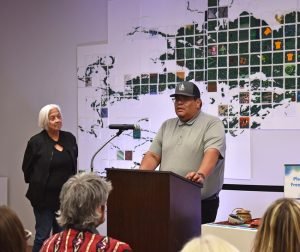
A celebratory gathering was held for the Lake Nipissing Beading Project, now in its fifth year, at the Nipissing University Student Union Student Centre on November 27.
On the wall behind the team speakers at the podium hung the 444 beaded squares that comprise the map of Lake Nipissing and its tributaries. The extraordinary work was started during the COVID-19 pandemic for isolated people to stay connected.
Now, Nipissing First Nation and Dokis First Nation will share the care-taking of the five-metre collaborative work of art.
Nipissing First Nation councillor and community historian Joan McLeod Shabogesic is of the Heron/Crane Doodem. She spoke about the map’s future and the many teachings in the map.
“It has a lot of our Doodemaag on there that we’ve researched. It also has a lot from the artists themselves, the beader. They have their own story to tell for every one of those tiles. We’re hoping that in the future, we start gathering more of that information on why people beaded a certain way and what were they trying to symbolize. There’s also beadwork on there that some of our beaders did in different stitches and in different patterns. So, that is a very intricate part of this thing, too. If somebody was studying beadwork, they would be able to get a teaching from this map. Somebody would do the Navajo stitch or somebody’s doing a two-stitch or a two-needle.”
McLeod Shabogesic says the map’s importance is going to grow, as are the number of stories stitched in it.
“It would be nice to see a picture of the person (tile creator) so that could go down in history, too, to be carried forward. You would see people of all colours, all creeds, all backgrounds, and their interaction on this. Because we really don’t know who the beaders are. We know some of them, but there are probably a lot of people that contributed that don’t even know this map is up yet.”
Nipissing First Nation beader Belinda McLeod spoke with Elders about tiles before she began her designs. Her mother Darlene McLeod beaded 26 tiles. Joan McLeod Shabogesic beaded 31 tiles. Her famous ancestor was the inspiration for her first beaded square.
“I did do it on the mouth of the Sturgeon River. That was my very first tile ever. I wanted to pay homage to my great, great, great-grandfather Chief Shabogeshig, who was the signatory of the Treaty. That was his homeland. And, if you know about our history, we lost that land. It is now being occupied by the municipality of West Nipissing. That’s where my great, great, great-grandfather is. There’s a burial ground there.”
McLeod Shabogesic explains there is a sturgeon at the bottom of the tile.
“I put it there because it was a sturgeon spawning bed and our people went there every year to catch sturgeon. And I also put, if you look really closely, a heron. And the heron was my grandfather’s bird. The heron or the crane is a Chief’s symbol in our Doodemaag. So, I did that. That was my first one and then I progressively got better and talked to my sister-in-law Darlene (McLeod) on how to bead. I actually learned how to bead. And I don’t have the greatest hands to do it either. Anybody can bead and anybody can tell a story.”
McLeod Shabogesic reminded the gathering about Josephine Beaucage who travelled to 33 reserves in Ontario and Quebec to reteach people about beading. Joan’s Aunt Ruth was a student of Josephine.
“I also want to tell you about Muriel (Sawyer-baa) with her little ones and her story. She was a friend of mine, a childhood friend. I put up here a tile for Muriel(-baa). It’s a raven there with a yo-yo. Muriel(-baa)’s nickname was Yo-Yo. She was always talking in Nishnaabemwin classes. The proper word for no is gaawiin, but a lot of people just say caw. So, she would go ‘caw, caw.,” McLeod Shabogesic recalls. “It means a lot to our people that we are going to be seeing this history. And I’m sure as we go along and look at these beautiful tiles that people have made, it will tie into every piece of our history. For people going forward, can you imagine 50 years from now, two generations? A little girl goes up and says, ‘Oh my god, my grandma Glenna did that.’ They can actually touch that tile. To me, it’s a personal thing going forward. And it’s a legacy for our people.”
McLeod Shabogesic spoke of the Lake Nipissing Beading Project partnership with Dokis First Nation as the most important thing.
“It’s a way of reaching across this beautiful great Lake Nipissing and building our relationship through care-taking of an exhibit. Care-taking of this beautiful map – it’s going to be here forever.”
Dokis First Nation Lands Administrator Randy Restoule, Mukwa Doodem, says the First Nation doesn’t have the resources to research on their own and gave appreciation for the opportunities to work and share with Kirsten (Greer) and Nipissing University.
“The tile that I chose for this project, is not on Dokis land but historically it was a post where Chief Dokis had his main operation. It’s at Dokis Point on Nipissing First Nation.”
Restoule talked on the digital dimension of the map.
“The ongoing work that could be done in relation to getting those oral stories attached to it. It’s going to continue to grow. As the project moves forward, different ones will carry the work on. It’s going to continue to evolve. We do have templates ready that we could use for the administration of this map.”
The journey continues for the Lake Nipissing Beading Project and its highlights of connections between people and the land. Nipissing First Nation’s Glenna Beaucage opened and closed the event.
“Dokis and Nipissing (First Nations) will work hard to take care of this map and provide due honour to all the work that’s been done. And it leads to sacredness of water also as Grandmother Lorraine (Whiteduck Liberty) constantly reminds us of the life blood of Mother Earth is our water. We have to give voice to the water.”
Beaucage thanked Nipissing University for taking care of the historical, geographically correct, beaded map as the two neighbouring First Nations continue to share the caring of the map.
To read more on the project and to watch the informative presentations, visit the Lake Nipissing Beading Project.