

NHL’s Minnesota Wild makes history with Ojibwe broadcast
By Sam Laskaris
SAINT PAUL, MINNESOTA – Baabiitaw Boyd had an instrumental role in having a little bit of history made.
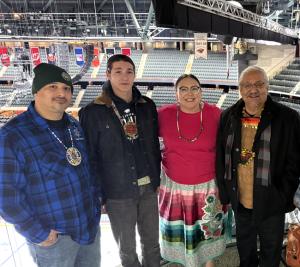
Boyd, a teacher at Bemidji State University in northern Minnesota, was a driving force behind the first Ojibwe broadcast of a National Hockey League (NHL) game.
And now she’s hoping that not only the Wild continue Ojibwe broadcasts, but other Minnesota pro franchises follow suit and do the same.
The Minnesota Wild home contest, versus the Colorado Avalanche, was broadcast in Ojibwe on Nov. 28 on the FanDuel Sports Network website and app. The broadcast was held in conjunction with Native American Heritage Day.
Boyd said she had been invited to do the invocation for the Wild home rink, Grand Casino Arena, after it was renamed this past June via a naming rights deal with her tribe, the Mille Lacs Band of Ojibwe.
“When I went there, and I did the translation of that, I was sitting with VPs and leaders from the organization from the Minnesota Wild,” Boyd said. “I was sitting with our executive team and we were just sharing in a conversation when the owner of the Wild talked about opportunities and talked about a partnership and wanting to have a good relationship with the tribe.”
Boyd immediately suggested having Indigenous broadcasts of Wild games. A few weeks later, she received an email asking if she was interested in doing just that.
“I knew that I didn’t know enough about hockey to do it justice,” Boyd said.
But she asked three others, including her 17-year-old adopted son James Buckholtz, to handle the play-by-play and commentary of the match.
Gordon Jourdain and Chato Gonzalez also worked the broadcast.
The three-man broadcast crew were invited to sit in on two previous Wild home games before their historic match.
“They were invited to wear the technology and the headphones and the microphones so they could experience what that would be like listening to the producers and listening to themselves talk about the game,” Boyd said.
Boyd added she plans to have discussions with Wild officials to have more of the team’s games broadcast in Ojibwe.
“I’m a brand new hockey fan now and I’m like supercharged,” she said. “I’m ready to make a proposal to have all the rest of the season games be in Ojibwe. And I have a hope for that to happen. And also, we have next season if that doesn’t work out.”
Boyd said she will also approach a couple of other Minnesota pro franchises, the National Football League’s Minnesota Vikings and the Minnesota Timberwolves of the National Basketball Association, to see if they are willing to have Ojibwe broadcasts of their contests.
“There’s no reason why we can’t push and drive this into all spaces and that we can’t make this normal,” she said.
Boyd said she had yet to receive a number of how many people tuned in for the initial Ojibwe broadcast for the Wild.
“But we are having hundreds of thousands of likes and shares on multiple platforms, Facebook and Instagram and other social media spaces,” she said. “There are lots of likes and shares and engagement that’s happening.”
Boyd is hoping that the positive feedback thus far proves to the Wild and to FanDuel Sports Network officials why this is necessary and how many people want to see this happen.
“It doesn’t hurt anybody to do it,” she said. “It really doesn’t. And so, I’m hoping that we can get that little shift to be made.”
Boyd is also a founding member of the Midwest Indigenous Immersion Network (MIIN).
“What we do is we partner with the local immersion schools in Minnesota and Wisconsin and we try to support them with program assessment and recommendations for strengthening their programming, their instruction, professional development opportunities for their staff, and we also curate and make publicly accessible curriculum for all ages from pre-school to PhD,” she said.
Boyd said that while the Ojibwe broadcast was generating interest, MIIN representatives were simultaneously promoting the MIIN.
“We were kind of plugging our organization at the same time so that people could get to know that there’s an organization out there that is trying to make as many adult proficient speakers as possible so that we can kind of inject them into the education space,” she said.