

Students find Indigenous Art and Creativity therapeutic at Nipissing University
By Kelly Anne Smith
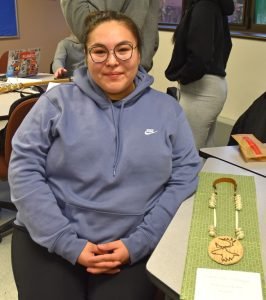
NORTH BAY—Nipissing University Assistant Professor Jonathan Pitt is proud of the remarkable work of his students in his Indigenous Art and Creativity course. Their final assignments were on display during the Artwork Sharing Gallery on November 26.
Pitt says the activity is an alternative to using a traditional Western European final exam in a gymnasium.
“We decided to go this way to help the students be recognized for their efforts and their learning over the course because art represents the earliest forms of expression until contemporary times. We’ve studied everything from early forms like petroglyphs and pictographs, right up to contemporary art, looking at both the visual arts and drama and music. We looked at really notable people like Thomspon Highway, Tom Jackson, and Douglas Cardinal, who is an architect. It’s a really unique course in that way that the students get to experience the real beauty and differences that are exhibited across Indigenous expression. As we say in the Anishinabek Nation, art is at the heart of it. It’s the heart of everything that’s done. And it’s connected with identity. When we talk about moccasins and leather work, and bead work, we can tell what community someone was from based upon how they styled their moccasins. Those elements resonate in the fabric of what students have studied.”
Professor Pitt says student Merle McLeod’s beadwork is transformative. McLeod entered a perfect, colourful beaded lanyard for his final assignment. Beading is close to McLeod’s heart.
“As a child, I remember witnessing my grandmother work with beads while growing up in the community of Waskaganish First Nation. Beader Elvira Nowlin, one author from an article I read, states that she wants to work with beads because of her cultural background and personal experiences. She feels a connection to her ancestors through the process of beading. Beading has been a therapeutic connection that I feel when I bead and a close connection to my grandmother, an ancestral connection. I was interested in beading from a very young age. Unfortunately, I never pursued beading since I thought it was a craft best left to women until I saw other men challenge societal gender standards. I began beading after my brother-in-law introduced me to this art form and I have since come to love it. I also have created an Instagram account, The Beading Man, where I display some of my beading.”
Student Jocelyn Pitt is in the Bachelor of Social Work program. Jocelyn’s multi-media project is on Indigenous activism.
“I was a part of the protest that we had on campus about Mike Harris and our amazing Harris Learning Library. I really want to shed a light on local Indigenous activism that we have here. I wanted to show Indigenous activism in a local sense. A lot of the students in this class are non-Indigenous, but also not from this traditional territory. I wanted to showcase in this traditional territory and what Indigenous activism has looked like recently. And for a lot of Indigenous students on campus, a really big issue for us has been that, it says the Harris Learning Library,” explains Pitt regarding Harris’ relationship with Indigenous people that is generally defined by his role during the Ipperwash Crisis in 1995, during which his government’s handling of an Indigenous land claim protest led to the shooting death of Dudley George by the Ontario Provincial Police. “Students don’t feel safe going into a space like that when we have Mike Harris himself coming onto campus and making Indigenous students feel uncomfortable. And how, these places were not always made for us, but we’re here. And we deserve to have that space. And our Treaty Learning Centre is in the Harris Learning Library that we spend a lot of time in.”
From Uashat mak Mam-Utenam, Innu Nation, student Vanessa Joseph beaded the profile of a caribou with size 13 beads.
“We were assigned this project to reflect on what we saw in the class and how Indigenous people use art as a medium in their everyday life to honour animals and honour ceremonies and honour their more-than-human relatives. This is where my inspiration comes from. I really wanted to honour the caribou because my ancestors were hunting the caribou for time immemorial. They used to make the beautiful caribou coats, the hand-painted ones. Those coats were worn during the hunt. They were made to bring honour to the caribou,” explains Joseph. “This is my modern take of honouring the caribou with what I have at home…This is beadwork on birchbark with cowrie shells and ivory hair bone pipes. I really wanted to use those noble materials because this is my way of honouring the life of the caribou. The caribou is why I’m here today and why my ancestors survived all those years.”
Raven Koostachin painted Wawatay in vibrant water colours. From Attawapiskat First Nation, Raven says wawatay is northern lights in Cree.
“I grew up on the land all the time as a kid. My dad would take us out hunting or camping a lot. So, I wanted to create a piece that represented back home. Something that is special to me. Growing up, my late grandmother, my kokum, would say the northern lights are past relatives dancing. It’s a special moment when they come out. They come out a lot up north, where I’m from. They’re so beautiful in person, especially when we go spring hunting. It’s pure darkness with trees (evergreens) and bright northern lights. It’s a special painting to me because it’s something I see a lot back home. My first thought when I see it is that it’s a special place to me.”
Koostachin says she found the course and artwork therapeutic.
“I love art. I’ve always admired people making art. I enjoy looking at it. It’s just something I’ve always had an interest in. I knew, when I first applied for this class, it would be an interesting class to be in.”