

Petroglyphs park season ends under access issue
By Kirk Titmuss
CURVE LAKE FIRST NATION TERRITORY – About 30 visitors from several First Nations across Ontario converged on the Kinoomaage Waapkong (the Teaching Rocks) at Petroglyphs Park in Curve Lake First Nation territory last October to participate in a day-long closing ceremony.
The Teaching Rocks are one of the largest examples of First Peoples rock art outcroppings in Canada, with hundreds of hand-carved petroglyphs, believed to have been created over 6,000 years ago. The carvings are a visual portrayal of the Algonquin-speaking peoples’ lives and spirituality. They feature stories of animals, people, and the Spirit World. The site is considered sacred and a living entity by the Anishinabek.
Among those in attendance included former Curve Lake First Nation Chief Dr. Keith Knott, Curve Lake Councillor Jeffrey Jacobs, Curve Lake Elder and former park staff member Lorenzo Whetung, Anishinabek Nation Southeast Regional Chief Marsha Smoke, Trent University professor Jack Hoggarth, and several staff members of Parks Ontario and the Anishinabek Nation. The event was coordinated by Anishinabek Nation Government Relations Coordinator Kevin Restoule.
After a Sunrise Ceremony, attendees took turns in the first of two talking circles sharing life experiences with the Teaching Rocks and what the location means to them today. Many had visited the site decades ago as children and spoke fondly of their times there.
Curve Lake councillor and Kinoomage Waapkong Committee member Debra Jacobs says she first visited the site as a young girl in the 1950s with her aunt. Years later, as a daycare worker in her community, she and other staff would bring children to the site.
“They would enjoy the rocks too and we’d tell them about, give them a little insight on what they (carvings) meant and what they continue to mean to us.”
Unfortunately, they don’t mean as much to some. Parks Ontario staff and Curve Lake First Nation citizens both say there are frequent incidents of people disrespecting the site, ignoring photography and video recording restrictions, disregarding barriers, climbing on the Teaching Rocks, and vandalism. Park personnel, several who are Curve Lake citizens, say it’s become a real challenge to both protect the site and encourage visitors to explore and learn from the carvings.
Former park staffer and Curve Lake citizen, Lorenzo Whetung, feels the preservation of the Teaching Rocks is paramount.
Southeast Regional Chief Smoke calls it a magical place and agrees that it needs protection.
“I believe that the work they are doing to revisit the stewardship of this territory is really important because, definitely, we need to have the preservation and it’s really a matter of protecting our history and providing that place for our young people, our younger generations to learn the history here, and to appreciate it.”
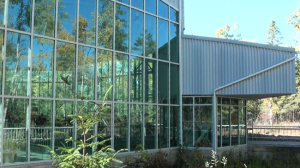
In 1984, a glass and steel building was constructed over the main outcropping of rock carvings to protect them from the weather and vandalism. Anishinaabe ancestors covered the carvings with moss to hide them and preserve them. Although the building is a far more effective, protective barrier, some say the structure restricts the spirituality of the site, that it’s unnatural and unsightly. It’s become another issue for the Kinoomaage Waapkong Committee to address.
Curve Lake Councillor Jeff Jacobs says he approached the Anishinabek Nation Chiefs-in-Assembly in Fall 2024 to get guidance on what needs to be done to meet all protocols at the Teaching Rocks, but at the same time protect them. He adds that the provincial government also needs to hear what the Anishinabek Nation First Nations feel is the right direction for the site.
“We need to strike a good balance to how we’re allowing others to access this site. We, of course, want citizens of the Anishinabek Nation to always have access to this site anytime and that has been granted, we do have that now. But how we’re looking after this site physically as well, in terms of the building, all of the infrastructure, roads— the accessibility, it’s not easy to access if you have accessibility requirements —and so on and so forth. So, we really want to be mindful and respectful of how we’re doing these things.”
Jack Hoggarth, Chair of Anishinaabe Knowledge and assistant professor within the Chanie Wenjack School for Indigenous studies in Peterborough, conducted the opening and closing ceremonies at the park. He feels there isn’t a way to meet the access requirements of both parties.
“I don’t know if there’s a solution. That solution, it’s going to be one-sided. It’s either going to be we’re going to open up for tourism and we’re just going to have to be a side product and wait until what we’re doing right now, or we shut down the park, and we continue our ceremonies as we have.”
Hoggarth says another approach to the access issue, one that came up at the closing ceremony, is removing the protective building and letting the site go back to its natural state, as it was in the beginning and eventually replace the current petroglyphs.
“We talked today about maybe someday that, those markings and those teachings it’s time for them to go. And so be it, if that’s what the Creator has in store for that, we’ll find new ones, or we’ll make new ones. Maybe we’ll make new ones.”
But that direction is highly unlikely as all who gathered at the closing ceremony agreed on the site’s importance to the Anishinabek Nation, and its history. Councillor Jacobs says it goes to the very roots of Anishinaabe connectivity.
“It’s not art. It’s a conveyance of teachings. There’s spirit. There is connection. We’re all one big Anishinabek family and this is just more evidence of that and how we’re all connected. The clans and the symbols and the teachings on the rocks all connect to how we walk on this earth and the things that we believe and how we live.”
Until a solution to the access issue is reached, the Teaching Rocks will continue to silently do what they have done for millennia.
Former Curve Lake First Nation Chief Dr. Keith Knott previously discussed the history and significance of Kinomaage Waapkong, and touching on incursions from geologists, academics, and the province of Ontario since the 1950s on the Anishinabek Nation Bemaadizijig Ganoonindwaa: Talking to People podcast.