

When Rivers Were Trails: Learning through interactive gaming
 Reviewed by Karl Hele
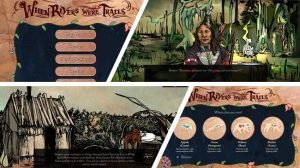
When Rivers Were Trails is a fun educational game released in 2019 that you can download to play on MAC and PC. It was designed by Elizabeth LaPensee and brought to the screen by a diverse set of more than 30 Indigenous creators, writers, artists, and designers. It was developed in collaboration with the Indian Land Tenure Foundation and Michigan State University’s Games for Entertainment and Learning Lab, thanks to support from the San Manuel Band of Mission Indians. This makes When Rivers Were Trails an important piece of Indigenous-centric edutainment for children and adults. The game is about the impact of colonization on the Anishinaabeg, Dakota, Crow, and other nations in the United States West during the 1890s. It is set during the era of allotments, boarding schools, and the attempted consolidation of nations onto ever smaller pieces of land.
The game itself is a 2D point-and-click style modelled after Oregon Trail. You will follow maps of lands from Minnesota to possibly California – I never made it past Fort Peck without starving or dying from an illness. During your journey, you will be presented with directional options of North, South, East, and West – each choice brings a different experience and piece of knowledge. Your game experience begins when you flee your lands, which had been allotted, before the settlers arrive – this is done in haste and fear. Thus begins your journey in search of peace and home. You will meet other Anishinaabeg, Dakota, or Crow peoples, who will welcome you and offer stories, knowledge, gifts, or items to trade. Be careful, however, if you are too generous, your well-being (health) counter will run out, and you will perish. Also, you need to regularly gather berries, hunt, fish, or perhaps trade for food to stave off starvation. Hunting is straightforward by using a bow and three arrows to shoot deer or rabbits. Do not miss, as it takes two arrows to collect deer meat. Fishing is a bit easier. After some practice, a stab with a spear will always land a meal. Gathering or trading for medicines also helps you survive onslaughts of disease or serves to help other Indigenous people you will meet. When you assist people, well-being increases; albeit, if you engage in resistance, depending on the outcome, you risk losing or gaining well-being. Deciding to engage or avoid resistance is difficult as you are helping people hold onto their lands, exercise treaty rights, or simply do the right thing. Be wary of Indian Agents who will continually harass you as you travel, often confiscating food, medicine, and assaulting you.
While the interactions with in-game characters are often far too short and brief, you will learn about Anishinaabe culture and language, the 1890s, allotment, colonialism, as well as its effects on individuals, families, and communities. The game designers embedded our language, Anishinaabemowin, within the game. Words such as Niiji are followed in brackets by the English translation. Dakota and Crow are included as well, but not treated in the same manner – it seems to be designed to provide a basic Anishinaabemowin vocabulary. While the graphics are basic (think Oregon Trail, which the game mimics in many ways), playing the game provides a fun way to learn and pass the time. Importantly, it is from and by Indigenous peoples, which, unlike its model, the Oregon Trail, and as such, is from the perspective of Indigenous people. Violence, dislocation, and upheaval are settler-created – the Anishinaabe, Dakota, and Crow characters and you, the player, are trying to survive while seeking new opportunities, engaging in community building, practising culture, learning tradition, and importantly, understanding the impacts of American colonialism.
Overall, When Rivers Were Trails is an excellent game. Its quest, travelling from Minnesota to California, appears simplistic, but it is actually difficult not to die along the way. Before your character perishes, lessons will be learned – historical and cultural, as well as game play – that will enable you to travel a bit further, thereby increasing knowledge, the next time. While it is all U.S. colonialism, I believe the ideas could readily be adapted for an Anishinaabeg context within Canada or the Great Lakes overall. Being educational, enjoyable, and suitable for a variety of ages, I heartily recommend that you download the free game and give it a try.