

Wiikwemkoong buys Edmonton commercial property for $65 million
By Sam Laskaris
WIIKWEMKOONG UNCEDED TERRITORY – A bold step could potentially become a precedent-setting move for First Nations.
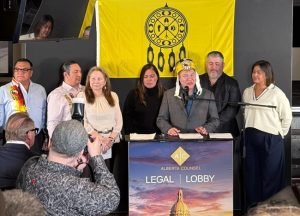
At a news conference on Jan. 23, it was announced that Wiikwemkoong Unceded Territory, located on Manitoulin Island, purchased Connect Centre, a downtown commercial real estate property in downtown Edmonton, for $65 million.
The plan is to expand the property and add as many as 35 storeys of residential units.
“I believe it’s kind of rare that a First Nation does leave its own traditional territory to invest in a different province,” said Wiikwemkoong Unceded Territory Ogimaa Tim Ominika. “I viewed this as a very unique opportunity for our First Nation.”
Now that the purchase is complete, Ogimaa Ominika said Wiikwemkoong officials are keen to get to the next phase, spending about another $100 million to construct the property’s residential units.
“We’re looking at trying to start that immediately,” he said, adding that it will take about four years to build.
Ogimaa Ominika said buying property in Alberta is indeed a significant deal for his First Nation.
“It’s going to put us on the map in one sense,” he said. “I was looking at it not only as a property acquisition. I was looking at this opportunity as a way of building more relationships, with not only other First Nation communities out west, but any other business development opportunities we may have.”
Ogimaa Ominika also believes it will be a profitable initiative for Wiikwemkoong.
“This investment is going to allow us to become more financially independent, by creating our own source revenue to support our housing needs, healthcare needs, our Elders, our youth, and services for all members, not only on it but off-reserve,” he said.
And he also believes it could lead to other projects that Wiikwemkoong invests in.
“What I was envisioning here, too, was not only going outside our province alone as a Nation, but how could we build a relationship or collaboration with other Anishinabek Nation communities, collectively coming together to make big purchases like this?” he said. “It’s not only our community that is able to do this. We could do a joint venture with other First Nation communities.”
Anishinabek Nation Deputy Grand Council Chief Chris Plain also believes other First Nations could be interested in following Wiikwemkoong’s lead.
“I see it as a great opportunity for collaboration,” Deputy Grand Council Chief Plain said. “This is a very challenging process, as you can imagine. So, I imagine it will open opportunities for other communities to approach Wiikwemkoong to determine how they made this possible and some of the challenges [they had]. And then hopefully they’ll adopt some of the optimism that Wiikwemkoong has for a project with this scope.”
Deputy Grand Council Chief Plain, a citizen of Aamjiwnaang First Nation in southwestern Ontario, praised Wiikwemkoong officials for thinking outside of their own borders.
“I do see it as a catalyst for change,” he said. “My community itself has invested off-reserve in industrial operations, not so much commercial. But some of the times, the opportunities don’t exist within the community. So, I see it as somebody is taking a chance outside of their community to turn around to make the profits better for their community.”
Deputy Grand Council Chief Plain said his First Nation was involved in large-scale windfarms outside of its First Nation.
“The difference being ours were contracts,” he said. “So, they’re going to have an end life. But what I see with Wiikwemkoong, there’s no end life. This is going to be sustainable development, sustainable revenue for generations to come. And I hope the best for them. It seems like just a tremendous opportunity for revenue generating, to turn around and use that revenue for the betterment of their community in whatever way.”
Anishinabek Nation Lake Huron Regional Chief Scott McLeod said he’s aware of other First Nations in the country that have invested in ventures outside of their own province, but Wiikwemkoong’s deal is believed to be historic.
“I don’t know of any others in the Anishinabek Nation,” Lake Huron Regional Chief McLeod said. “But I do see this becoming more of a trend as far as making investments to generate more sovereign wealth for communities and being able to move away from dependence of government funding. I see this as being a real positive example of what some of our communities can do to create a better financial future.”
Lake Huron Regional Chief McLeod said he isn’t surprised that it was Ogimaa Ominika’s First Nation that has taken charge.
“Wiikwemkoong has always been a bit of a leader when it comes to our Anishinabek communities,” he said. “And so, by them taking the initiative and looking at investing outside of their community and outside of their region, really is a bold step in looking to secure opportunities to create sovereign wealth… And I think other communities will look at it and probably consult with Wiikwemkoong for advice on how they did it and what’s working for them and what’s not. At the Anishinabek Nation, our communities are very tight-knit communities that share successes and help each other grow and prosper.”
Ogimaa Ominika said not all Wiikwemkoong members were on board with the idea of buying property in Alberta.
“I know some people are afraid when doing this because I think when we are doing a large, huge investment like this, it’s kind of difficult for our membership to understand what we are trying to do collectively for the benefit for the Nation,” he said. “It is a large investment. But we did an appraisal on it to make sure it was a good investment. The appraisal on the building is $122.5 million. And it’s only eight years old.”
Ogimaa Ominika is confident Wiikwemkoong made a wise decision.
“Leadership reviewed multiple opportunities and moved forward with this one because it offered the strongest culmination of value, stability, and growth potential at that time,” he said. “And I think it will open a lot of doors and open a lot of opportunities for other First Nations who are willing to do something like this. I’m so excited because I’m already getting asked to do presentations of how we did this.”