

Anishinabek Nation hosts Aboriginal and Treaty Rights Conference
By Laura Barrios
CHIPPEWAS OF RAMA FIRST NATION—The Anishinabek Nation hosted the Anishinaabe Miinwaa Gchi-Kwiinwinan Nkweshkdaadiiwin – Aboriginal and Treaty Rights Conference on February 12 in Chippewas of Rama First Nation.
The goal of the conference was to understand and help evolve Aboriginal and Treaty rights with the help of special guest speakers and Anishinabek Nation leadership in attendance.
“In every society, people are maybe not necessarily fully aware of their rights, or maybe there are some people that abuse their rights,” says the conference MC and Anishinabek Nation Commissioner on Governance Patrick Madahbee. “It’s important that we learn about the responsibility that comes with rights.”
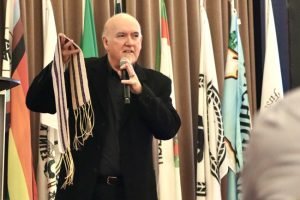
The conference opened up with Anishinabek Nation Head Getzit Richard Assinewai, who shared insights about inherent rights, sang to the wampum belt and the Anishinabek Nation Eagle Staff, and recited the Ngo Dwe Waangizid Anishinaabe, the preamble to the Anishinabek Nation Chi-Naaknigewin (constitution).
“The way we do it is Native Law. What are those laws? There are five of them. We follow those laws. One of the first ones is Sacred Law – creation stories and treaty relationships. That’s a sacred law. Number two is the Natural Law – relationship with the land, the Spirit of the land. The third one is Deliberative Law – those are talking circles, feasts that we have, council meetings, and debates. The fourth one is the Positivistic Law – proclamations, rules, regulations, oaths, teachings, and wampum belt readings. And number five is Customary Law – it’s our inheritance – family relationships and recent land claim agreements. That’s Native Law. We need to follow them the best way we know how.”
After being welcomed to the community by Chippewas of Rama First Nation Councillor Ted Snache, Anishinabek Nation Deputy Grand Council Chief Chris Plain provided remarks, emphasizing the importance of the conversations that will take place during the conference.
“Now, I get calls regularly from community members from the three communities in our area asking about this or asking about that, and it’s time that we have this conversation, that we start this dialogue about treaties so that our people at home understand their rights, understand the history, understand the sacrifice.”
Anishinabek Nation Legal Department Director Fred Bellefeuille was the first of many presenters to enlighten participants, presenting on Aboriginal and Treaty Rights: The Basics and Moving Them Forward to Support First Nation Goals.
“It’s important to understand the evolution of our control of our Aboriginal and treaty rights, but we have to steer them.”
Oracle and educator Clayton King explored Traditional and Treaty Territories: Binding Kinship, Intermarriage, and Migration to Land-Based Rights, through key historical documents such as the Post-War of 1812 – Treaty of Peace; The Monroe Doctrine; President Andrew Jackson’s Indian Removal Act of 1830; Treaty 45 ½; and the Imperial Proclamation.
Several partners and associates from Olthuis Kleer Townshend (OKT) LLP, a law firm dedicated to advancing the sovereignty and prosperity of Indigenous governments, organizations, and peoples, shared updates and information through several presentations throughout the conference. Though their presentations were not legal advice, the presenters offered expert legal perspectives grounded in their extensive knowledge and experience.
OKT partner Renée Pelletier discussed Aboriginal Title and Private Property and what you need to know, namely that these endeavours are litigious and thus, lengthy and costly.
“And so, the reason these title cases can sometimes take decades is that they’re effectively all of these particular different topics, whether it be to hire an expert, who has to go write an expert report. And then the Crown gets to respond with their expert, and that can take years, and years, and years,” explains Pelletier. “Just flagging that because I think that Aboriginal title is exciting and that there’s some real possibility for communities, but I don’t want it to be presented as a quick thing that people can just launch a claim. I think communities really have to be prepared to invest in.”
OKT partners Matt McPherson and Jaclyn McNamara, and associate Jesse Abell, updated participants on the Métis Nation of Ontario’s interface with Aboriginal Treaty Rights.
“Continue to lobby and educate, both the government, folks locally, and the general public because that is really important to helping people understand the issue in the long-term. One of the issues, I think, why it has been able to go so far is that at present, government doesn’t really see the cost to doing this. It thinks it’s some sort of harmless thing to do and that it has no impact on First Nations. And so, you are seeing it has an impact on your communities, that’s something that’s important to share and to tell them. And then lastly is collaborate and coordinate. There are lots of First Nations in Ontario who are working very hard on this,” stated McPherson.
OKT Partner Corey Shefman and Associate Jesse Abell discussed the United Nations Declaration on the Rights of Indigenous Peoples (UNDRIP) and Free, Prior, and Informed Consent to Protect Your Rights.
“You’re going to hear that UNDRIP, in the aspect regarding informed consent, that they’re incompatible with the duty to consult,” explained Shefman. “In the federal court of appeal for one of the interveners in the Kebaowek case (Kebaowek First Nation v. Canadian Nuclear Laboratories, 2025 FC 319), and one of the things that the government entity who was appealing the case said is exactly that; that the Duty to Consult is simply incompatible with UNDRIP. You can’t have consent and the duty to consult in the same discussion because they’re too incompatible. And we say that that that’s just not true, we say that they’re not incompatible, but that they complement each other…UNDRIP elevates the duty to consult. It creates additional obligations that speak to the same critical protective tasks that the duty to consult was intended to do initially.”
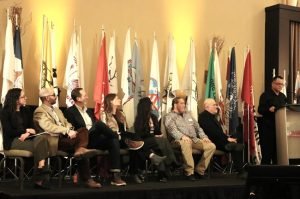
The Aboriginal and Treaty Rights Conference – Anishinaabe Miinwaa Gchi-kwiiwin concluded with a Question & Answer session featuring all guest speakers, which offered an opportunity for participants to bring forward any questions or concerns relating to their community in the areas of Aboriginal and Treaty rights.