

Chiefs discuss relationships with municipalities at Toronto conference
By Sam Laskaris
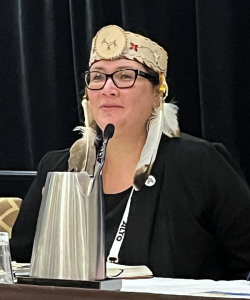
TORONTO – Anishinabek Nation Grand Council Chief Linda Debassige and Ontario Regional Chief Abram Benedict were among the Indigenous leaders featured on a panel at a Toronto conference.
Grand Council Chief Debassige and Ontario Regional Chief Benedict were panellists at a Jan. 19 session, which discussed the Indigenous reconciliation action plan released by the Association of Municipalities of Ontario (AMO), during the three-day Rural Ontario Municipalities Association (ROMA) conference.
The panel was titled Indigenous and Municipal Relationships – Actioning AMO’s Indigenous Relations Action Plan in a Meaningful Way. The panel also included Chippewas of Rama First Nation Chief Ted Williams, Temagami First Nation Chief Shelly Moore-Frappier, and Six Nations of the Grand River Chief Sherri-Lyn Hill.
Melanie Pilon, a citizen of Wiikwemkoong Unceded Territory, the first Indigenous mayor of the municipality of Wawa, chaired the panel.
During her remarks at the conference, Grand Council Chief Debassige brought up the Indian Act.
“It keeps us from doing things even to this day,” she said. “It’s really a pain in the butt to our Nations who really want to engage with better relationships with municipalities, proponents, economic opportunities. And it’s a real terrible thing, but we’re resilient.”
Grand Council Chief Debassige said her father taught her the importance of relationships with neighbours. She said these relationships will alleviate fear.
“And there’s also fear in starting a relationship to me,” she said. “And I make the connection of when we were all in high school, and we’re all going to a dance, and we were so darn shy to ask someone to dance. And so, the dance floor is empty. And then everybody is dancing. And that’s what it’s like sometimes until someone makes the first move…And oftentimes, the first move has to be done by the mayors of the municipalities or the leadership of the municipalities because our people are scared, too.”
Grand Council Chief Debassige said First Nations and municipalities face many of the same challenges, including road safety, housing and homelessness, mental health and addictions, as well as education and health-care concerns.
“We can be stronger together in rural Ontario by working together with our Nations and our municipalities,” she said. “We will bring more prosperity to our local areas.”
Ontario Regional Chief Benedict has been in politics since 2006, when he was elected as a district chief for the Mohawk Council of Akwesasne.
“I would say that, fundamentally, there’s really been a shift in the last decade about bringing not only Indigenous relations, First Nations relations closer with municipalities, but really around the commonalities that exist amongst our people,” he said.
The shift in thinking has been a positive one.
“There was hardly any priority on supporting, unfortunately, supporting members outside the community,” Ontario Regional Chief Benedict said. “And so that meant that they were in municipalities, in different settings with no real connection with the municipality, other than being considered Ontarian or a citizen of that area.”
Ontario Regional Chief Benedict said many municipalities are now providing services to many First Nations members, while at the same time, taking into consideration any sensitivity required for those needs.
Chief Williams has had a lengthy relationship with municipalities, as he was first elected to the Chippewas of Rama First Nation council in 1982.
Chief Williams believes it’s rather important for officials from municipalities to get to know First Nations representatives before getting into business with them.
“Spend time with them, [have] coffee, tea, lunch, dinner, go to their events, go to their pow wows, go to their special functions, find out who they are,” he said. “And you’ll be surprised what happens because some of my strongest relationships are with members of the municipal governments that we associate with.”
In his closing remarks, Chief Williams said First Nations leaders are very much similar to municipal heads.
“We have different rights, obviously, but we have dreams for our community, just like you have dreams for your community,” he said. “We’re passionate. We are innovative. We’re hardworking. We’re intelligent. And we’ve all moved our communities forward in the best way that we possibly can.”
Though he previously served his First Nation, in his current position, Ontario Regional Chief Benedict is helping to support 133 First Nations in the province.
And he continues to be a strong proponent of relationship building with municipalities.
“The era that we’re in is so fundamentally important that we continue to forge forward on our commonalities,” he said. “All Ontarians, all Canadians want to secure the economy of this country, but also want to do it, ensuring that the sovereignty of this nation is not compromised. And that’s something that our people understand since time immemorial.”