

Clayton King’s painting revealed at Waypoint
By Kelly Anne Smith
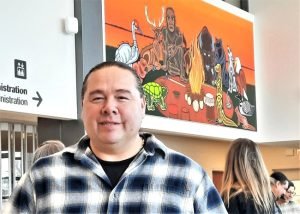
PENETANGUISHENE – The unveiling of the large-scale painting Mno Ishkode took place on January 30 at the Waypoint Centre for Mental Health Care in Penetanguishene.
Mno Ishkode is a 6′ by 15.5′ artwork by Clayton King, a Bodéwadmi (Potawatomi) Anishinabek artist and member of Beausoleil First Nation. King says the title of the painting translates to “the good fire”, but it’s also a reference to the Council Fire.
A Waypoint media release states that, “The piece reflects the area’s deep Indigenous history, as well as Waypoint’s commitment to cultural safety and reconciliation.”
The Seven Grandfather Teachings and the historic Third Council Fire are honoured in the painting. The Third Council Fire was located on the island across from Penetanguishene Bay.
The artist proudly talks about the important history that took place on the land that he painted into Mno Ishkode.
“The painting itself is a piece where we can reference history and the important understandings of territory that hasn’t really been written about or painted in the past. Within the piece, the animals represent the original Doodem or Clans. And they also serve as symbols of the Seven Grandfather Teachings, where they are all meeting in that Sunrise Ceremony conducted by ngig, the little otter,” explains King. “We all as Anishinabe have several council fires throughout our territory. Fires like this is where Anishinaabeg and many other First Nations transacted business, both internally and externally.”
King explains the Third Council Fire shown in the painting.
“It’s one of five council fires on the Eternal Council Fire Wampum Belt that stretched a road of peace between the Anishinabek and the Haudenosaunee Nations at the end of the Beaver War from Lake Superior to Northern New York State. This happened at the end of the 17th century.”
King says it was described by Chief Yellowhead or Musquakie and John Smoke Johnson (a Mohawk) at the famous 1840 Grand Council meeting in York, where the two men had renewed the peace between their nations.
“The Third Council Fire was said to be on that belt, on an island opposite Penetanguishene Bay, where it was placed to watch over the council fire. John Smoke Johnson stated that the emblem of the beaver was placed on an island on Penetanguishene Bay. That denotes wisdom,” he explains. “The place of the council fire has been an important place for Anishinabek for many generations at this island. It was a place of trade and rest from traversing the Great Lakes before entering the interior, what is known as the Trent-Severen Waterway today.”
The beaver, or mik, is a symbol of Nbwaakaawin or wisdom, one of the Seven Grandfather Teachings, says King.
“The five different animal symbols in each of the Council Fires have been referred to as main Doodems or Clans that are controlled in each of those particular areas on that road of peace. They become part of that sacred circle as well. And it’s an understanding that one isn’t above the other. We all need to treat each other as equals and care for each other. It gives the viewer a sense of belonging as well,” he states. “We have the Pike Clan situated in several First Nations in the Georgian Bay and the interior like [Chippewas of Rama First Nation] and Georgina Island, and across the Bay and territories in the Kiawartha’s and Mississaugas…We have the snapping turtle, mkinaak, the king of the Fish Clan. He is also a symbol of truth under the Seven Grandfather Teachings. The Fish Clan are known as intellectual peoples, comprising philosophers and stargazers.”
King says there have been archaeological digs in the area where the YMCA Camp Kitchikewana has been located for over 100 years.
“Parks Canada has had several digs over at that location and found 4,000-year-old artifacts. There’s a lot of information that’s been gathered from Parks Canada and from the Band. Things like copper items, pots, and porcelain.”
Artist Clayton Samuel King embraces teachings in his career.
“Understanding our history and culture, and learning language comes with being an artist. Everything accumulates together. It’s been a long road so far and still much more to learn.”
See King’s Mno Ishkode in the Atrium Building lobby at Waypoint in Penetanguishene.
About The Seven Grandfather Teachings (Submitted):
Wisdom (Nbwaakaawin) (Beaver) — To cherish knowledge is to know wisdom. Use your inherited gifts wisely and recognize your differences and those of others in a kind and respectful way.
Love (Zaagi’ idiwin) (Eagle) — Knowing love is to know peace. Our love must be unconditional — to love and accept ourselves is to live at peace with the Creator.
Respect (Manaadendamowin) (Buffalo) — Respect is not just an action, but a heart-growing feeling. To honour all creation is to have respect.
Bravery (Aakode’ ewin) (Bear) — Bravery is to face the foe with integrity. It is the state of having a fearless heart to do what is right, even when the consequences are unpleasant.
Honesty (Gwayakwaadiziwin) (Sabe/Raven) — Sabe reminds us to be ourselves and not someone we are not. To walk through life with integrity is to know honesty.
Humility (Dabaadendiziwin) (Wolf) — Humility is to know yourself as a sacred part of creation. It is to live selflessly, not selfishly, and to find balance within yourself and all living things.
Truth (Debwewin) (Turtle) — Truth is to know all of these things. It is speaking only about what you have lived or experienced; do not deceive yourself or others.