

Waasakwa Children’s Centre opens in Atikameksheng Anishnawbek
By Laura E. Young
SUDBURY – Staff are shovelling out the playground and building the play spaces outside—despite the ongoing winter weather.
“This playground hasn’t been played on yet. It was installed in the Fall. It’s beautiful,” says Amanda Rose, manager of the Waasakwa Children’s Centre. “We have a play structure in the pre-school yard, we have a sandbox area in the toddler yard.”
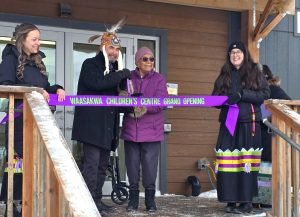
Waasakwa celebrated its official opening on Monday, Feb. 9, at Atikameksheng Anishnawbek First Nation, just west of Sudbury.
“It’s bringing that full idea into fruition. The registration, the enrolment is starting. The educators have even more motivation and spirit to have those little footsteps run through our front door.”
The centre features 40 spaces for children aged 18 months to six years, and there are six clients currently.
“As enrolment grows, we’ll open up more groups in our rooms. Right now, we’re starting with a small enrolment.”
The child care centre also has a bike track and is only the beginning for what Rose hopes for outdoor learning in the future.
“In addition to our outside space, we’re excited to go beyond that to land-based learning. Have our spots in community around where we can engage with other departments that may potentially be doing something. Or just go out there ourselves, look, listen, hear. Have them out in the air.”
Waasakwa was nearly 40 years in the making in Atikameksheng. Rose can speak to the final four years of the time it took to establish Waasakwa.
“Licensing, trying to get our space down, to actually have a building to operate in. There were still some facility hiccups, I would say. I would say the advocating part of it and getting the proper funding was probably one of the biggest struggles over the past decades.”
Then there’s also the national daycare crisis. Rose acknowledges the challenges, including retention, and the national advocacy for child care access in Canada.
“For us, it hasn’t been terribly difficult because we do have staff in community who have credentials,” Rose says. “Being in the community, we can use our community members to advocating, ‘Hey, look at what we can do.’ We can walk alongside the educational path with them, provide the opportunities for placements to our community members.”
There might be a crisis right now, but it’s a rewarding field, she adds.
“The more we get people to spread the voice, to speak up, then it can only get better from here. So just really advocating that retention, working with our post-secondary services here.”
Waasakwa will work to foster the language, and to do so, they have invested in the Chameleon Reader to play a key role in supporting Anishinaabemowin language learning and revival.
The books are customized, as well as for school-age, and all items and spaces are labelled. This way, when the Chameleon touches the pages and stickers, the words are spoken in Anishinaabemowin.
It’s also designed to support educators and build their confidence in the language delivery, Rose says.
“That creates consistency across all our classrooms and our centre as a whole because we also run an Early Years here, which is a caregiver-child-based program.”
For others looking to establish similar childcare centres, there were some key learnings for Rose.
“One of the lessons learned that I would want to share is [having] that early clear communication across all departments.”
It was important to invest in staff orientation and team building, she adds.
“We’ve been very grateful that we’ve had a handful of staff start with us since June [2025]. They worked on building their environments, building their curriculum, getting to decide what’s in their room, what they want to focus on.”
And also taking the time for team building and orientation, she says.
“We have a very good team over here. I’m very grateful.”