

Welcoming new life on the MV Indian Maiden passenger ferry
By Rick Garrick
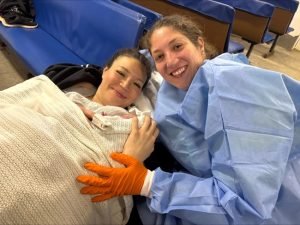
BEAUSOLEIL FIRST NATION — A group of Beausoleil First Nation’s on-duty paramedics recently delivered a baby boy on the MV Indian Maiden passenger ferry on Feb. 7 following a call for medical assistance at a residence in the Christian Island community.
“We did deliver a baby in the middle of the night in the middle of Georgian Bay in the ice in a snowstorm,” says Maggie Monague, primary care paramedic at Beausoleil First Nation Paramedic Services. “It is the first baby that was born on the MV Indian Maiden. This is one of our older vessels, it just happens to be the first time a baby has been born on this vessel.”
Monague says they are trained to do childbirth as paramedics.
“In this particular incident, it just so happens that we were on our ferry for much longer to get through the ice that night than we typically are,” Monague says. “This night we ended up on the ferry for two hours because we were trying to break through the ice through the snowstorm. When we had started transport we had a pretty good idea we were likely going to be delivering a baby. We were on the ferry for about an hour before the baby was born.”
Monague says they had transported the mother by ambulance to the ferry and then had to carry their ambulance gear with them onto the passenger ferry.
“Typically, we have a car ferry that runs, but we’ve got too much ice in our section of Georgian Bay so we are just down to a passenger vessel now,” Monague says, noting that the ferry only runs during the daytime but because it was an emergency, they had to make a special call to the ferry crew to mobilize the ferry. “So we transported the patient onto the vessel and then into an ambulance on the mainland side to go the rest of the way to the hospital.”
Bensen Carter, advanced care paramedic at Beausoleil First Nation Paramedic Services, says some of the firefighters helped them as well when they first got the call from the mother.
“They helped us be able to safely lift the patient out of the house and get [her] on to the stretcher,” Carter says.
Carter says they didn’t have a radio signal to call for backup or a cellphone signal to call for a doctor when they were on the ferry.
“We were kind of all on our own so we brought everything that we could,” Carter says. “We threw a bunch of our blankets on the ferry’s heaters, there were heaters on the ferry just to keep passengers warm, so we threw blankets on there to anticipate that if she delivers we would have lots of hot sheets ready for the baby.”
Carter says they were able to attach the ambulance stretcher to the floor of the ferry.
“So, we had the mom kind of on the stretcher and it was pretty much a standard delivery with all the obstetrical equipment that we had,” Carter says. “One of the things that was unique was trying to figure out how much oxygen we might need to bring just given the delay from the ice.”
Christos Bamparamos, paramedic superintendent at Beausoleil First Nation Paramedic Services, says the paramedics team, which also included Rob Rawson, primary care paramedic at Beausoleil First Nation Paramedic Services, had to work in unusual conditions.
“They were in a boat, it’s very loud, the boat is not warmed up because it was like since 10 o’clock [when they used] it,” Bamparamos says. “They did everything they needed to do like putting the blankets on the heaters to make sure that they had all the resources there — we are extremely proud of them, they really did a terrific job.”
Tony Filice, paramedic chief at Beausoleil First Nation Paramedic Services, says it was great to see the successful delivery of the baby by the paramedics on the ferry.
“It’s not really a big part of our job, but certainly a very great and impactful thing when it does happen,” Filice says, noting that it is difficult to predict how quickly a mother’s labour will progress. “[With] our situation being on the island, it’s not a simple thing to kind of just get into the car and go to the hospital, especially through the winter months. In the best case scenario we’re an hour from the hospital, and an hour is some times just way too long.”