

Anishinabek youth featured on panel at Toronto conference
By Sam Laskaris
TORONTO – Devon Patterson realizes there are still many First Nations people who have misconceptions of the mining industry.
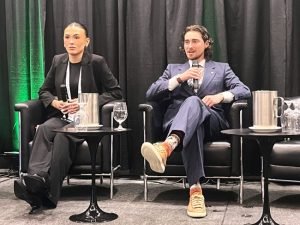
Patterson, a member of Serpent River First Nation, talked about this issue recently as he was a panellist at the Prospectors & Developers Association of Canada (PDAC) conference, held March 1-4 in Toronto, Ont.
Patterson spoke at a Mar. 2 session titled Looking to the future: Indigenous youth in the mining sector. The panel also included Josee Filion, a member of Dokis First Nation. Filion is the Indigenous relations and business opportunity coordinator for PowerNorth Utility Contractors, which operates in the mining, utilities, and renewables sectors.
Patterson explained why he believes some First Nations people are still critical of mining.
“I think a lot of where that feeling comes from is that since time immemorial, Indigenous people have been stewards of the land and the waters of Turtle Island,” he said. “And in the context of the historical damages and the history of the mining industry and the malpractice of the past, it’s understandable that communities and Nations would be distrustful of industry and governments who are trying to develop projects within their traditional territories.”
Patterson said in the past, mining initiatives were completely extractive in nature, where a lot of times, communities and Nations never saw any benefits.
“And so, of course, they are skeptical of that today,” Patterson said. “And I think it’s imperative that, going forward, that the mining industry and governments work to collaborate and consult, as is the law, with Indigenous Nations to properly and reasonably advance resource exploration and resource extraction projects.”
Filion told conference attendees of how she landed her current position. She had heard a story through a friend who had helped communities on the James Bay Coast get off diesel generators.
“I thought that was a very inspirational story and I thought that it would be really cool if I could work on a project like that someday,” she said. “So that’s how I got my start.”
As a young Indigenous woman, Filion said she has not received any negative feedback about being involved in the industry.
“I personally haven’t faced any backlash but I can see how someone coming into your backyard with a bulldozer isn’t really a good thing,” she said. “My family and my friends are totally supporting me in my journey. I think as youth right now, we have a really cool opportunity to be up and have a seat at the table and share our perspectives and how we can take advantage of our positions right now.”
As for Patterson, he’s still in school. He’s a fourth-year student at Laurentian University in Sudbury, Ont., doing a major in Earth sciences with a minor in environmental chemistry. But he has some valuable work experience as well. He worked for Ontario Geological Survey for two years as a geological field assistant and spent last summer working for Alamos Gold as a geological field mapping assistant.
Like Filion, Patterson said he hasn’t encountered any negative feedback about being in the industry.
“I think I’ve been very well supported by my community and by other Indigenous people within the space,” he said. “It’s not easy to fulfill and manifest a positive and good future, especially in a lot of remote communities and on-reserve. And so, I’ve been particularly blessed to have people who support me. And I think that my community has done really everything reasonable to help me fulfill my goals.”
It’s a career he hopes to continue pursuing.
“The mining industry, as many of us know, it offers an opportunity to be out on the land, like not many other careers do,” he said. “I got to spend two years flying around in helicopters, being in boats, traversing through the woods. There’s not a lot of careers out there that really give that opportunity.”
Filion and Patterson also stressed the importance of First Nations youth to have other First Nations individuals they can look up to in their fields.
“The biggest thing is visibility,” Filion said. “If you’re seeing people from your community in these roles, it really motivates you. I’ve had the opportunity of attending lots of First Nation conferences and making friendships and mentorships. And I know I can turn to any of my peers and ask for advice. And I know they’d be honest with me and give me good advice.”
Patterson echoed this sentiment.
“Role models and mentors are extremely important,” he said. “We stand on the shoulders of giants who have blazed their trails before us. And if an Indigenous youth sees their Elders and their role models advancing in executive positions within an industry, they’ll be encouraged to follow those means themselves.”