

First Nations designer provides youth perspective at Toronto forum
By Sam Laskaris
TORONTO – A question Caitlin Wemigwans is occasionally asked is whether her Indigenous-designed streetwear is exclusively for Indigenous people.
“I create everything with the intention of anybody being able to wear it,” said Wemigwans, a Wiikewemkoong Unceded Territory citizen who is the owner/designer for her company, Pre&Peri. “So, I make sure that people know that. They don’t have to be afraid to wear what I create.”
Pre&Peri products are streetwear featuring designs inspired by Woodland Art, nature, traditional teachings, and dreams.
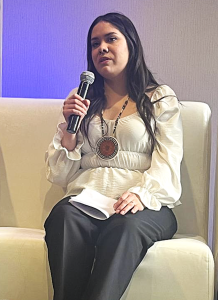
Wemigwans provided details about her company, which she launched in 2020, at the Canadian Council for Indigenous Business (CCIB) forum held in Toronto on Feb. 26.
Wemigwans was a speaker on a panel titled From Boardrooms to Business Plans: Youth Perspectives on Entrepreneurship and Professional Leadership. Wemigwans said non-Indigenous people often are not looking for Indigenous clothing other than the annual Orange Shirt Day, held each September, as they’re worried about cultural appropriation.
“They don’t know what else to even look at,” Wemigwans said. “And there would be potentially the fear of appropriating or just not knowing anything.”
Wemigwans also said there are plenty of ways for non-Indigenous people to educate themselves about what they can wear. Providing examples, she said people can read books, follow Indigenous businesses and social media influencers, and they can also start learning a little bit on their own.
“I do personally like to provide some education as well,” she added.
Due to the growing awareness around economic reconciliation, Wemigwans was asked during her panel presentation if she had an increased demand from wholesale buyers wanting to engage and source products from Indigenous brands, beyond National Indigenous History Month or Orange Shirt Day.
“I can’t afford to offer a traditional wholesale model,” Wemigwans said. “So, a lot of times, it would be offering half of a retail price. If I do that, I make nothing. So, that is one downside of ethical production. I’m still passionate about it. I still want to do it. So, I do still do it. And thankfully, I’m in a position where I can be picky and make those decisions about who I’m going to work with.”
Wemigwans added that her company did take part in a breast cancer awareness campaign.
“I put out some pink shirts,” she said. “It was a pink version of my resilient sun shirt. So, a lot of people have connected to the resilience and artwork and message. And one of the most common stories I hear is ‘I have cancer and I think this would really help me out, or my friend has it.’”
Wemigwans said she had also received a comment from an individual who had cancer and was left with marks on arms from chemo or treatments. Thus, that person was inquiring about a long-sleeve shirt.
“So, when I put out the pink shirts, I had two versions,” Wemigwans said. “One was a light colour. And one was a dark colour, just for some variety. But also, one was long-sleeve, and one was a short-sleeve because I remembered that story. That was from the first year that I started. And, yeah, I remembered it. It just stuck with me.”
Wemigwans also said she is hoping to continue to grow her business.
“I would like to expand a bit more and maybe look at having a line that’s not made on Turtle Island,” she said. “It just wouldn’t be able to feature that artwork that I’m known for.”