

First Nations support transmission line deemed as priority project by Ontario government

By Sam Laskaris
BARRIE – First Nations leaders are among those praising a provincial initiative on a transmission line that has been designated as a priority project.
At a news conference in Barrie earlier in February, the Government of Ontario announced its desire to build a transmission line from roughly Barrie to Sudbury, a distance of about 290 kilometres. And it declared Hydro One would develop and construct the line, which is expected to create about 9,000 jobs in the process.
The proposed line is part of the Ontario government’s plan to boost economic growth in the northern portions of the province.
The transmission line has the backing of 11 First Nations, who have joined a group called the Energy Corridor First Nations (ECFN) consortium.
This group includes the following First Nations: Alderville, Mississaugas of Scugog Island, Henvey Inlet, Dokis, Shawanaga, Wahnapitae, Magnetwan, Moose Deer Point, Nipissing, Atikmeksheng Anishawbek, and Wasauksing.
Provincial officials had signed a Memorandum of Understanding (MOU) with the ECFN consortium this past December. That MOU established the fact the parties had mutual objectives, principles of co-operation, and a framework for joint engagement on the initiative.
The goal is to have the new transmission line in service by 2032.
Not all of the First Nations currently in the ECFN consortium are directly in the path of the proposed transmission line.
“We were involved once it became clear that the line starts in Barrie, which is part of the Williams Treaties catchment area,” said Alderville First Nation Chief Taynar Simpson. “So, we’re not right on that energy corridor. There was about five or six First Nations that were part of the Energy Corridor First Nations group. So, we came in a bit after the fact. And we have since then signed on to the MOU. We’re only there because it’s in our treaty territory.”
Chief Simpson believes his First Nation will still benefit from the transmission line.
“We benefit in terms of our treaty territory being recognized as something that needs to be duly consulted with for any sort of major projects happening on our territory,” he said. “So, we’re not going to be leading per se because it is going to be those First Nations along that corridor that would have the biggest say, the biggest concern. But we want to make sure over-all, First Nations rights aren’t being infringed, that everything is going to be done properly.”
Chief Simpson also likes the fact that Hydro One has been designated to lead the initiative.
“Hydro One has been a good partner in the past,” he said. “And we have no reason to think that won’t continue.”
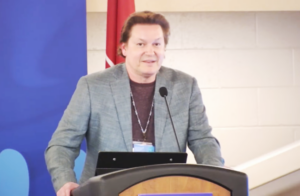
It remains to be seen how much Alderville will gain financially from the project.
“I think that’s something that still needs to be hammered out,” he said. “I know that these projects generally include a 50 per cent ownership for First Nations. And then the ones that this is actually running through their reserves, they’re going to be the ones that would benefit the most from this… We benefit less so just because Barrie is in our territory. But most of the line is actually going to be outside of our treaty territory. So, our benefits wouldn’t be as significant as [other] Energy Corridor First Nations.”
Chief of Mississaugas of Scugog Island First Nation Kelly LaRocca is also pleased her First Nation has jumped on board with the consortium.
“We are making it simpler for governments and Hydro One to do the right thing from the very beginning – meaningful First Nation participation is built into this project, not added at the end,” she said.
Chief LaRocca also believes there will be many benefits flowing from this deal for First Nations.
“This agreement opens the door to careers, business opportunities, and long-term ownership in the infrastructure that runs through our treaty and traditional territories, so that the benefits of this corridor finally flow to the First Nations who have always cared for these lands,” she said.
Shawanaga First Nation Chief Adam Pawis said those in the ECFN consortium realize the transmission corridor from Barrie to Sudbury must be strengthened to support future energy needs. And he’s looking forward to First Nations involvement in the proposed line.
“We anticipate that real First Nation participation in the project will clear away unnecessary delays and roadblocks, and advance prosperity in our communities through First Nation ownership and participation in employment and contracting opportunities, business ventures, and through long-term involvement in the management of energy infrastructure within our lands,” he said.