

Lakehead University helps build community research through hide-tanning
By Rick Garrick
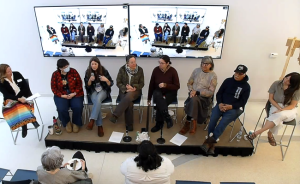
THUNDER BAY — A group of hide tanners and researchers shared their hide tanning journeys during Lakehead University’s Weweni Zhichge: Building Community Research Together Through Hide-Tanning Panel Discussion on Feb. 26 at the CASES Building Atrium. The Weweni Zhichge: Building Community Research Together Through Hide-Tanning project was recognized with one of two Indigenous Partnership Research Awards later in the day at Lakehead University’s 21st Annual Research Excellence Awards.
“How I came to hide-tanning, I was hired to teach and research in Indigenous law, Anishinaabe law at the law school and I was spending a lot of time sitting in my office … figuring out how I was going to do my research,” says Larissa Speak, an assistant professor at Lakehead University’s Bora Laskin Faculty of Law and Fort William citizen. “But I very quickly realized that wasn’t really going to work; I needed to be in community and I needed to be engaged in land-based practices in order to do my job properly. I did a bit of work at the sugar bush and just doing some other things like that, but then I saw Fort William had advertised a Spring Hide Camp.”
Speak says she went to the camp, and Jean Marshall, a hide tanner and Kitchenuhmaykoosib Inninuwug citizen who lives in Fort William First Nation, put her to work at the deer-hide tanning station.
“It was great and I got this intensive experience to work with Jean, but also with Nate Johnson, who comes up from Minnesota to help us with our deer hide-tanning program at the Fort William camp,” Speak says. “And I spent five days doing the work and it was just really fun and it was really great. For people who’ve been to hide camps, the vibe is so nice and welcoming, and there’s just so many different people there with different skills.”
Marshall says she first became involved in hide tanning during a month-long residency at the Banff Centre for Arts and Creativity.
“I sat with two Elders for a month with 20 other people and we tanned two hides,” Marshall says. “I was an observer, I hardly even put my hands on the tools, but it was, like, amazing. A year later, I was at an art gallery talking about how we need money to do a hide camp here. We need to do this here; this needs to be something that becomes normal again because a long time ago, all the ladies in all the communities, they all were doing hides in the yard. They all needed to because they needed the leather to make footwear, hats, jackets, clothing, snowshoes, all the things from those animals they needed to actually survive to be outside on the land.”
Keira Loukes, an assistant professor at Lakehead University’s School of Outdoor Recreation, Parks and Tourism, whose father is an Alderville citizen, says she was first involved with a hide during a drum-making workshop while in university.
“That sort of sparked my interest,” Loukes says. “Before that, I didn’t have that connection, I didn’t grow up in Alderville, I didn’t know those teachings before and that program helped introduce me to it and planted a little seed.”
Loukes says she brought a hide with her in her vehicle when she moved to Thunder Bay.
“While I was here in that first year, I would work on my hide that was thawing, and go back freeze, thaw, freeze, thaw, on my balcony in Port Arthur (northern part of Thunder Bay) every time I needed a break from working on my PhD,” Loukes says. “There was something about using your hands that … just grounds you…And then, thankfully, Denise (Baxter, vice-provost Indigenous Initiatives at Lakehead University), who was working on a moose hide with her class, gave kind of an all hands call out to say, ‘Hey, we need to soften this hide, come over,’ and I joined Denise that day. We were there all day in your basement and many different people came, your aunt came and we got to meet all these people.”
The other hide tanners and researchers who spoke during the panel discussion were Leigh Potvin, an associate professor at Lakehead University’s School of Outdoor Recreation, Parks and Tourism; Shelby Gagnon, a hide tanner from Aroland; and Charlotte Marten, an Anishinaabemowin teacher from Kitchenuhmaykoosib Inninuwug.