

The 3rd Indigenous Language Conference welcomes Susan Aglukark to North Bay
By Kelly Anne Smith
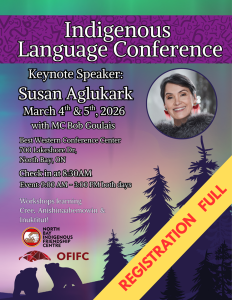
NORTH BAY – Susan Aglukark will headline the 3rd Annual Indigenous Language Conference hosted by the North Bay Indigenous Friendship Centre at the Best Western in North Bay, Ont., on March 4 and 5. Popular workshops will teach Cree, Anishinaabemowin, and Inuktitut.
The North Bay Indigenous Friendship Centre Executive Director Kathy Fortin says providing language support is part of the strategic plan of the Friendship Centre. She says the Friendship Centre community is cheering on the 2026 Language Conference.
“It’s the interest of our community, our membership, that’s why we continue to. Our first annual one (Language Conference) was a complete success. We didn’t think it was going to be as big as it was. And, just by basing that on evaluations that were taken at that time, after the conference, they suggested we have more.”
The executive director outlines the exciting 2026 itinerary, saying that having Susan Aglukark attend the 2026 Language Conference is a really big deal. Aglukark is a famous Inuk singer and songwriter who speaks on the importance of preserving the Inuktituk language.
“We are very, very happy to have her here. I’m glad that she accepted. She will be doing one of the workshops and will be the keynote speaker. We try to incorporate Ojibwe, Cree, and Innu in our programming, whether it be a workshop on Inuit language or Ojibwe language. They’re going to have a Cree bingo where they call out bingo in Cree.”
Velma Assisnawai will be instructing the Anishinaabemowin workshop and Nathalie Restoule will be part of the conference as well.
Taking up the language is embracing culture, says Fortin.
“A big part of our culture is our language. When you look at other languages, it’s a word. Whereas in the Ojibwe or our Cree language, we’re describing something, we are not just saying a word. You know, for a flower, it describes that flower. Like sunflower, waawaaskonenh, what we vision is what the word is.”
In learning a language, one is learning important details of the culture, states Fortin.
“A lot of our names come from nature. Let’s say, red sunset (bangishimon). It is a beautiful word in Ojibwe. Our words describe what we are talking about.”
Fortin says Inuit Day in November at the North Bay Friendship Centre is a big success thanks to event planner Traci Koritsaris.
“She is on her learning journey, too, which is good. I think being employed by the Friendship Centre has brought her closer to that. Traci is also the coordinator for Inuit Day. We had our second Inuit Day where she brings in people from Labrador to share the language and their traditions.”
Fortin says that learning the language brings a sense of belonging that is nurturing and brings us closer to our traditions.
“A lot of people come here who have either lost their language or their traditions. So, when they’re around the familiarity, because they were probably around it as little children, and then having that familiar sound again creates a sense of belonging. They hear the language, and they hear the older ones. The younger ones are speaking more and more nowadays. It nurtures you and nurtures your soul and brings you back to when you were younger. And kind of heals some traumas that have happened throughout your life.”
The master of ceremonies of the conference is Nipissing First Nation’s Bob Goulais.
“We have Bobby Goulais coming. He’s very knowledgeable about anything Indigenous. On language and culture, he’s so knowledgeable.”
MC Goulais shows everybody is connected when he warmly introduces family members as presenters at conferences.
“That’s the way Indigenous people are. Whether it’s my uncle, my auntie, my brother, my sister. They might not be blood related, but you’re still my sister.”
The senses for the outdoors will be heightened with natural accents on the tables.
“That’s actually what we try to do with the language conference. Making sure to have things that are visible. You know, the medicine’s there and all different kind of things to get people’s senses going.”