

Anishinabek First Nations strengthen future through economic development
By Rick Garrick
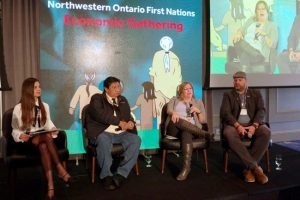
THUNDER BAY — Wiikwemkoong Unceded Territory Ogimaa Tim Ominika, Red Rock Indian Band’s Kirstine Baccar, M’Chigeeng First Nation’s Steven Debassige, and Anishinabek Employment and Training Services’ John DeGiacomo were among the speakers at the Northwestern Ontario First Nations Economic Gathering in Thunder Bay.
Baccar spoke during the Panel Discussion: Investing for Seven Generations that opened the gathering, Ogimaa Ominika delivered a keynote address on the first afternoon, and Debassige and DeGiacomo delivered breakout sessions on the second morning of the gathering, which was held April 22-23 at Delta Hotels Thunder Bay.
“We look at what aligns with our strategic plan that’s driven by our community members often times, and it’s got to align with our values, it’s got to align with our long-term vision and our laws as well, how it affects our overlapping territories — we have to look at all different aspects when we’re considering development,” says Baccar, director of economic development at Red Rock Indian Band, during the panel discussion. “I know revenue matters obviously, but it shouldn’t be the sole measure when we are looking at who we are partnering with. Our nations need strength, we need to be self-determining and positioned for our future generations.”
Baccar says they are involved with some renewable energy projects that were just announced.
“We are 50 per cent owner in one and then 40 per cent between a couple of communities,” Baccar says. “We’re definitely looking at the revenue side of things as opposed to before.”
Baccar, who was one of the Red Rock Indian Band councillors when the Nipigon River Bridge was being built right next to their community, says they had to fight for benefits.
“The first year, there was nothing, so I started meeting with all the unions and meeting with the proponents and MTO (Ministry of Transportation) and Hatch Mott MacDonald — getting them to take on our engineering student and mentor them for the duration of the project, hiring a community liaison that will continuously coordinate between community and project,” Baccar says, noting they also took over the shuttle bus contract and rented out office space for the project. “We fought for one in every third person that were to be hired on that bridge should be a Red Rock (Indian) Band member, so by the end of the next season … we had 26 out of 50 people working on that bridge.”
Ogimaa Ominika highlighted how his community invested in the Connect Centre in downtown Edmonton during his keynote presentation.
“Today, the story is about doing something differently, this was about seizing an opportunity that will benefit our future generations — it is about what is possible when the youth of tomorrow are the heart of the decisions we make today,” he says, noting that they completed the “landmark commercial real estate acquisition” on Jan. 21. “It’s popular down in the ICE District, right in downtown. And as of Jan. 21, when we made that acquisition, our community can now proudly call it the Wiikwemkoong Connect Centre. And I can also let everyone know as we listen to some of the other milestones of our communities that this is 100 per cent Wiikwemkoong and Indigenous-owned.”
Debassige, cultural integrity lead at Indigenous Tourism Ontario, highlighted some of their Indigenous Ingenuity exhibit pieces such as a wild ricing canoe during the Indigenous Tourism Ontario breakout session.
“This one is interactive, kids will sit in here and the video monitor will show them what wild rice means to First Nations people,” Debassige says. “They will go through the practice of using the rods to bang the rice out of the grass. They’ll hear and see and do, and that’s how we learn; by listening, by seeing, and by doing, and when we can, we’ll understand better what wild rice means to First Nations people.”
DeGiacomo, executive director at Anishinabek Employment and Training Services, says he talked about their Indigenous Skills and Employment Training (ISET) program during the AETS Youth Training Opportunities breakout session.
“Anishinabek Employment and Training is one of eight ISET holders in the northwest, so we shared what ISET holders do to help youth,” DeGiacomo says. “As an example, we are going to be running two trades training programs starting this summer that will help youth continue if they’ve just finished high school, or if they are out of work and out of school and they want to join the training program, we offer those programs.”
DeGiacomo adds that ISET holders traditionally have summer opportunities as well.
“So we let the audience know that we have wraparound supports if they have youth that want to go through programs or if they are an organization that would like to employ youth, then yes, ISET holders can help in those regards,” DeGiacomo says.