

Dilico Anishinabek Family Care gathering empowers young participants with knowledge and strength
By Rick Garrick
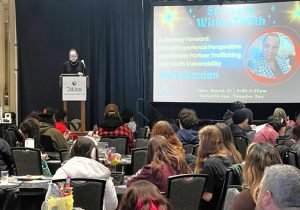
THUNDER BAY — Dilico Anishinabek Family Care’s Strength Within YOUth gathering featured A Journey Forward: A Lived Experience Perspective on Intimate Partner Trafficking and Youth Vulnerability presentation by Alicia Gordon. Held March 31 at the Valhalla Hotel and Conference Centre in Thunder Bay, the gathering was aimed at youth aged 12–17 and focused on anti-human trafficking awareness and prevention.
“I was invited to speak from a perspective of lived experience as a former victim of intimate partner trafficking, which is a little bit different than human trafficking,” says Gordon, whose family is from a First Nation in Manitoba. “I was brought there to explain what the differences are and to also provide knowledge from my lived experience perspective, while also offering education on some really critical components that can actually put us at risk for trafficking as a young person.”
Gordon says some of the subjects she covered were consent, boundaries, power, and control dynamics, what a healthy relationship is and is not and what sex work is and is not.
“[I presented] all these different topics to provide the young people in the room with key knowledge that they need to basically keep themselves safe, to prevent potential situations of trafficking or intimate partner trafficking occurring in their own lives,” Gordon says. “One of the things that I really like to focus on when I’m talking about young people is really understanding what consent is and understanding how that works, what a safe relationship is, what power and control is, and also understanding how we’re vulnerable when we use substances, especially alcohol or illegal substances, and how they can actually contribute to increasing our risks.”
Fort William First Nation’s Corine Bannon, Native language teacher at Algonquin Avenue Public School in Thunder Bay, says she attended the gathering with Grade 7 and 8 students from Algonquin Avenue Public School.
“Educating our youth, our students, is important so that the youth can make informed decisions — there are many who are naive and don’t recognize the signs to human trafficking,” Bannon says. “Dilico’s anti-trafficking presentation also provided information on the risk of online dating, how online predators can manipulate a youth who does not recognize they’re at risk. The organizers provided a safe space for open discussions, hands-on tools for stressors or for those uncomfortable topics.”
Brianne Harrison, Ojichaagwan Ani-Mino Aya (Anti-Human Trafficking Program) manager at Dilico, says they have a six-bed facility at Dilico for 12 to 17-year-old youth of all genders and identities who are either at risk of exploitation and human trafficking or have been confirmed to be exploited.
“So we do a journey for them towards recovery and empowerment, and this day was really about bringing education and awareness about how human trafficking impacts our communities and how we can build their confidence, develop their skills, recognize their inner strength through interactive activities, dialogue, and reflection,” Harrison says. “It was just really important to bring the topic up to the youth. This event was open to 12 to 17-year-olds, as well as adults and chaperones that could come with them just to learn about some red flags and bring some awareness [about] how we can prevent further people from entering trafficking and exploitation.”
Harrison says Dilico’s Ojichaagwan Ani-mino-aya (Anti Human Trafficking Live-in) Program offers both a cultural approach and a clinical approach to promote the healing and well-being of Anishinabek people.
“We honour community values, their culture, their traditions, and we try to weave that in with the mental health support, working on really important life skills for them,” Harrison says. “When they come to the home, there are six different beds; they have their own bedrooms and then we have two youth intensive treatment counsellors that are on every shift, and then we also have clinical coordinators and a cultural coordinator. We do a lot of hands-on activities, programming, cultural events, so going out on the land, doing land-based counselling, some mental health supports, things like DBT (Dialectical Behavioural Therapy) skills and really just building up their self-esteem and their self-worth, so they have that resiliency to sort of take on all the challenges that happen outside of the home.”
Harrison says they also have an aftercare program for youth who are transitioning back to their home communities, school, or work.
“There’s variety of ways they can get involved in the program,” Harrison says. “If they are ready for bed-based treatment, then they do the referral and they come to the site, but sometimes for youth, that can be really intimidating, so some people will just reach out and get the support in meeting them where they are at in the community or the surrounding First Nations.”
The gathering also featured presentations on Exploring the Four Sacred Medicines: Teachings and Creating Your Own Medicine Pouch by Reigna Rose, DMs to Deepfakes: Staying Safe Online by Kris Carlson; Understanding Human Trafficking by Ontario Provincial Police Detective Constable Aliina Reccia; and Building Your Own Coping Kits by Amanda Pettis and Harrison.