

First Nation leaders encouraged by new child welfare system
By Sam Laskaris
TORONTO – Anishinabek Nation Southwest Regional Chief Joe Miskokomon has spent decades fighting for changes to First Nations child welfare programs.
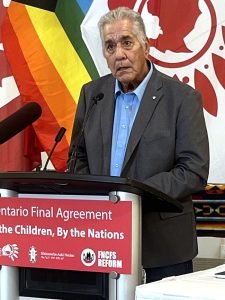
Thus, he was understandably thrilled that he was able to join other First Nation leaders in Toronto on Mar. 29 to provide details on an historic agreement.
Earlier in the day, Mandy Gull-Masty, the federal minister of Indigenous Services Canada, announced Canadian officials would be providing $8.5 billion in federal funding to revamp child welfare programs in the province.
The Ontario Final Agreement (OFA) was negotiated between First Nations and the federal government. And it was finally approved that day by the Canadian Human Rights Tribunal (CHRT).
A key takeaway of the Agreement is that it affirmed the inherent right of First Nations to care for their own children and to design services based on First Nations’ laws, traditions, and priorities.
First Nations children and families in Ontario will now have access to fair, culturally-grounded community-led services.
Finalizing the Agreement took numerous years because it was exactly a decade ago, in 2016, that the CHRT ruled Canada must end its discriminatory funding practices against First Nations’ child welfare services.
During a news conference, staged at the Chelsea Hotel in downtown Toronto, Southwest Regional Chief Miskokomon thanked many of those involved in the lengthy process, which included technicians and frontline workers that have participated over the last number of years.
“It’s been a long journey,” said Southwest Regional Chief Miskokomon, who is also the Chief of the Chippewas of the Thames First Nation. “We’ve come not to the end but to a new beginning. It’s been a tough journey. And it is a journey that is no more important than anything else that we have.”
Chief Miskokomon said First Nations leaders are ready to get to work with the new child welfare system that will be in place.
“Today, we start with a new approach, an approach that is not an agency approach,” he said. “The approach is in the rightful place – a child-centric approach. What we do from here on is our responsibility. We said we wanted it back. We got it back.”
Chief Miskokomon also provided some advice to his fellow First Nation leaders.
“Think carefully,” he said. “Choose wisely. Engage your communities. Engage your people. They have the answers. This is a building process. It’s a building-block process. And like any journey, it starts with one step. Today, we make that step. Today, we start to carve our path, our story, our history. And a legacy that we leave behind is in your hands.”
He also stressed leaders should treat the new Aagreement with respect and honour.
“Engage your people, including your Elders,” he added. “And engage the people that are going to be affected the most – the youth. They have a voice, too.”
For now, Chief Miskokomon is pleased a new First Nations child welfare system will be implemented.
“I look forward to the new tomorrow,” he said. “I look forward to a new pathway. Nothing has been more sacred or important to any of our people than the little voices that we have and the future of those voices.”
Other First Nations leaders who attended the conference were Ontario Regional Chief Abram Benedict, Alvin Fiddler, the Grand Chief of the Nishnawbe Aski Nation, a political organization that represents 51 First Nations in Northern Ontario, and Joel Abram, the Grand Chief of the Association of Iroquois and Allied Indians, an organization that represents about 20,000 members from eight communities in Ontario.