

Incredible photos and teachings in new book, Niagara Escarpment: Land between the Waters
By Kelly Anne Smith
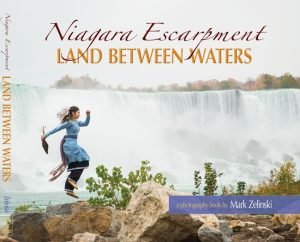
WATERDOWN—Niagara Escarpment: Land Between Waters is a remarkable new photobook by Mark Zelinski, rich in natural and cultural imagery with Knowledge Keepers and scientists sharing insights. Zelinski calls this book a 14-year odyssey of the escarpment and its peoples.
While working on his previous book, The Heart of Turtle Island: The Niagara Escarpment, Zelinski learned of the many Indigenous communities on the escarpment, from Niagara Falls to the west tip of Manitoulin Island.
“I realized very quickly that I needed not only to do separate chapters on the individual Nations of the escarpment lands, but to have Indigenous chapter writers to write those stories because I know it’s always better if people can tell their own stories.”
In the just-released book, historian and Knowledge Keeper Dr. Alan Ojiig Corbiere of M’Chigeeng First Nation writes about Mnidoo Mnising (Manitoulin Island).
Chief of Mississaugas of the Credit First Nation Margaret Sault explains that her Anishinaabe First Nation was denied title to its lands, yet was invited by the Iroquois Confederacy to relocate to the Six Nations Reserve.
Tim Johnson, Brian Kon, Lenore Keeshig, and Caley Patrick Nadjiwon Doran also contribute to the formidable 320-page book with 600 superb photographs.
After Zelinski decided to do a sequel on the escarpment, the COVID-19 pandemic hit. He was given an opportunity, he says, when he spent two years off and on as the official photographer for Cape Croker Park at Neyaashiinigmiing Anishinaabek or Chippewas of Nawash Unceded First Nation on the Saugeen Bruce Peninsula.
“I have a lot of good friends at Neyaashiiningmiing. It was a great way to spend the pandemic on this beautiful land of Sydney Bay and the Cape Croker Peninsula of Nyaashiiningmiing. I was able to gather a lot of really good photographs of the communities and of the natural landscapes,” he recounts. “Also, I spent a lot more time on Manitoulin Island. I spent time with all of the six Nations there and met a lot of amazing people, including Josh Eshkawkogan (Wiikwemkoong Unceded Territory) who wrote a foreword in the book. There’s really a lot of photography of the Nations of Manitoulin Island. Some of which are not well known to people outside of Manitoulin. Some of them are very remote like Sheshegwaning First Nation. When I went to visit the Chief there, I was so welcomed…”
Carolyn King of Mississaugas of the Credit First Nation is also a foreword writer and an Order of Canada recipient.
“Carolyn is an amazing person,” says Zelinski. “Her work with the Moccasin Identifier Initiative is a national initiative which is about teaching Canadians about Indigenous peoples. I feel very fortunate to have her write a foreword in my book. She’s speaking at a book launch event in the City of Hamilton at Tourism Hamilton on April 29th.”
Zelinski hopes his photography helps bring awareness of the importance of the escarpment.
“When I started to work on the escarpment, back in 2012, I realized how many people in the populated area of southern Ontario that take these lands for granted. They are not even that familiar with them and don’t know what we have here. These lands are unique. There is no other landform in the world that has the same geological history as the Niagara Escarpment. It’s the rim of an ancient shallow sea that was at the centre of a continent called Pangaea, half a billion years ago. It had the largest coral reef in the world. A lot of the life forms that are on earth now began in that sea that’s surrounded by the Niagara Escarpment. It’s a fossilized coral reef. That creates this Karst geology that holds water,” he explains. “And it’s so important to our health, to our food supply, to our way of life, and the future of the earth that these lands are protected. If they learn how to love these lands and waters, then hopefully more and more people will decide to protect these lands and waters.”
The prolific photographer calls his publishing company his labour of love.
“Thirty years ago, I began a small company called From the Heart Publishing. I don’t really make a living from my books, although some of them have done quite well. I’m a commercial photographer. I make my living from that. My book projects are really to educate, to enlighten. And to date, I’ve donated 9,000 copies of my books to charities, mostly in Canada, but I’ve distributed the books worldwide.”
Zelinski’s gratitude for the teachings he has received in his travels is apparent in his dedication of Niagara Escarpment: Land Between Waters.
“In my work, not only in Canada, all over the world with Indigenous Peoples, I’ve done a lot of hiking and travelling through wilderness areas. I’m always amazed how Indigenous Peoples look at plants and animals as teachers. They evolved over hundreds of millions of years and every day over those hundreds of millions of years, they have to learn new ways to survive. Indigenous Peoples take knowledge from their behaviours,” he explains. “But I guess the most important thing is that recognition that everything that we see on this earth is alive. Not only alive, but it has a consciousness. And anything that’s conscious needs to be loved, needs to be respected. I think that’s the most important lesson that I’ve learned from Indigenous Peoples around the world. I think that is a way forward for all humans on this planet. If they can learn to love, really love the wind, the water, the trees, the rocks, and the land, then maybe we’ll have a better outcome for the future.”