

Nogojiwanong Friendship Centre celebrates its third annual Urban Indigenous Health Fair
By Rebecca Loucks
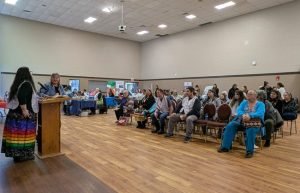
PETERBOROUGH—The Nogojiwanong Friendship Centre held its third annual Urban Indigenous Health Fair at the Healthy Planet Arena in Peterborough, Ontario, on April 8.
The Urban Indigenous Health Fair is an opportunity for relationship-building and knowledge sharing with local service health providers to support the wellness of the urban Indigenous population. It continues to grow year by year.
The Nogojiwanong Friendship Centre created these partnerships and collaborations with local Indigenous and non-Indigenous health service providers to support the urban Indigenous community members. The Nogojiwanong Friendship Centre’s mandate is to improve the quality of life for urban Indigenous people living in Peterborough and surrounding areas, and their mission is to strengthen Mino Bimaadiziwin.
Traditional knowledge holder, Liz Osawamick and her daughter, Florence, from Wiikwemkoong Unceded Territory, offered an opening prayer and song.
Nogojiwanong Friendship Centre Executive Director Lori Flynn welcomed the participants to the Urban Indigenous Health Fair.
“One of the most important things to emphasize is our understanding of health as something that is holistic,” she stated in her opening address. “Health is not just about the absence of illness. It is about balance. It is about caring for our physical, mental, emotional, and spiritual well-being. For many Indigenous cultures, this understanding has always been at the centre of how we live and care for ourselves and each other. When one aspect of our well-being is out of balance, it can affect all the others.”
This year’s keynote speaker was Kathy MacLeod-Beaver, Indigenous Navigator, Central East Regional Cancer Program at Lakeridge Health.
MacLeod-Beaver, a citizen of Alderville First Nation, offered teachings on the sacredness of our medicine tobacco, remembering fondly the knowledge carriers along her journey who helped with the teachings. MacLeod-Beaver invited women to come forward and join her with hand drums and shakers to offer a song about the welcoming of new life.
Franklin Johnson, a citizen of Chippewas of Rama First Nation, offered his teachings and experience with the big drum and offered drum songs for the enjoyment of the participants.
The local health service providers ranged from community health organizations dealing with mental health, youth services, women’s health, fitness care, cultural services and activities. There were approximately 20 displays set up at the event for participants to browse, learn from, and inquire about.
The health service providers were divided into four categories: physical, mental, cultural, and spiritual. The participants were given passports with each of the categories listed on the passport. Each category had four spots each to fill with a sticker from each of the health services providers. The participants were invited to gather information and have conversations with each of the health service providers. When the participants completed the passport, they were entered into a draw for a chance to win some beautiful, donated prizes.
Many of the staff of the Nogojiwanong Friendship Centre helped plan, organize and volunteer to bring the event to the community. It was a large collaboration to bring everyone together in the spirit of kindness, openness, and respect.
“That the relationships built today may make a meaningful difference in someone’s life,” adds Flynn. “Each person’s journey is unique, shaped by their experiences, their culture, their values, and their goals. What matters most is that you feel empowered to take steps, big or small, towards your own well-being. Having access to knowledge and trusted supports is what today’s event is all about.”
The Urban Indigenous Health Fair was well attended by the community, and everyone enjoyed taking part, whether they were a participant, speaker, or health service provider.