

Opinion: Canada’s Indian Act is 150 years old this April
By Karl Hele
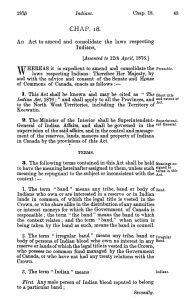
Passed on April 5, 1876, by the Liberal government of Alexander Mackenzie, and with the general support of the Conservatives led by Sir John A. Macdonald, the Indian Act became the core guiding document for First Nation-Government relations. This legislation was designed to combine various laws on the statute books since before Confederation, consolidating laws governing people, lands, and monies into a single convenient document. Although the initial Indian Act of 1876 was fairly basic, it established the groundwork for the subsequent 150 years, as it continues to be revised and amended to fit various political agendas and court rulings.
Since 1876, the Indian Act has sought to control First Nations. From 1876 until the 1950s, we were wards of the state, meaning that, legally, Indians were equivalent to children. This allowed the government and the Department of Indian Affairs (DIA) to administer and guide us toward assimilation. It defined ‘an Indian’ as male, with women being Indian in relation to a male, until 1985. Similarly, the Act allowed for enfranchisement – voluntary or compulsory. An individual could be enfranchised for attending university, living outside of Canada for five consecutive years, enlisting in the military, or marrying a non-Indian male. You could also ask for enfranchisement, provided you were ‘civilized enough’ and were able to pass a period of probation, to become a citizen of Canada. This voluntary clause was altered to eventually eliminate the probationary period and ‘civilized enough’ notions. All forms of enfranchisement were supposedly eliminated in 1985. The Act also determined band membership, often transferring women between bands based on marriage. This ended in 1985.
Besides controlling status, enfranchisement, and band membership, the Indian Act sought to govern our lands by placing reserves in trust with the federal government. This remains a key aspect of the Act. A court decision tied to the 1923 Williams Treaty confirmed that in the event of a Band’s ‘extinction’, all lands and monies held in trust will revert to the government. The Act also limits our ability to utilize our lands, creates location certificates to encourage the idea of land ownership, and establishes rules for leases and surrenders. One such clause, section 49A added in 1911, allowed for reserve lands to be taken or ‘surrendered’ if next to a city of 8,000 or more people. Railways, highways, telegraph, or phone lines, and other points of access were all permitted at various times under the Indian Act. Today, many communities across Ontario and Canada, more generally, are dealing with the impacts of these right-of-ways, leases, and surrenders obstinately carried out under the Indian Act and the powers of the Minister of Indian Affairs.
The control of our finances also occurred in a variety of ways. The federal government assumed from the outset that we could not manage our money appropriately. Based on this assumption, the government gave the Department of Indian Affairs power to administer trust funds, annuity payments, interest payments, and soldiers’ pensions. Trust funds were accumulated via land sales and leases, charges on forestry, resource extraction, and interest on the principle funds. For instance, these monies, the non-distributed funds, were then used to pay for the services of Indian Affairs, loaned to various institutions (i.e., McGill University), invested in ventures (i.e., the defunct Grand River Navigation Company), and used to fund road maintenance.
Gender discrimination also flowed throughout the Indian Act’s sections. This form of European-Settler discrimination, and the Canadian government’s efforts to ‘modify’ or ‘fix’ it, embodied evolutions within Settler society itself. Simply, the Indian Act was male-centric – Indians were defined as male, and women held status based on their relationship to a man. This allowed the government to force women who married non-Indigenous men from their communities, as well as remove their status. This practice was supposedly ‘fixed’ in 1985 when the marry-out provisions were removed. The new section of the Indian Act, however, solidified all previous status and enfranchisement rules by basing new status rules on the old. Since 1985, the Government of Canada has been tweaking the definition of status based upon the efforts of women, and some men, to overturn ongoing discrimination via the courts. Additional gender discrimination in the Act is seen in property inheritance rules that remained in effect until the late 20th century. Women were barred from participating in Band elections from 1876 to 1951. The aim from 1876 through 1985 was to teach Indians through legislation the appropriate roles for a civilized woman. Our Chiefs and people resisted these rules, but 150 years of masculine-centric policies have impacted our people. The current Bill S-2, An Act to amend the Indian Act (new registration entitlements), is part of the ongoing ramifications of how the Canadian state continues to define ‘Indian’.
There is much more to this twisted document, informed and maintained by colonialism, convenience, and sloth, as well as the impacts on our communities and people, to run through in a short article. Yet, it is also important to understand that for all the problems visited upon us by the Indian Act, there are a couple of twisted ironies. First, our current self-definitions and societal understandings of being Indian or Anishinaabeg or Haudenosaunee would not exist without the Act. Second, our lands controlled by the state and sought after by the state were also protected by the state. It is very speculative to wonder how things would have worked out without the imposition and enforcement of the Indian Act through time.
Despite many modifications and amendments as well as resistances and acceptances, the Indian Act has shaped and continues to shape Canada’s relationship with First Nations. Recently, two Prime Ministers, Stephen Harper (Conservative) and Justin Trudeau (Liberal), have respectively claimed that colonialism either did not exist or is an artifact of the past – a legacy. Yet, the Indian Act, as the very embodiment of colonialism in Canada, remains. For me, the Indian Act needs to be eliminated and replaced by a multitude of legislation that recognizes and supports First Nations’ sovereignty and rights; legislation that we as Nations support and possibly write. As a former head of the Assembly of First Nations noted in 2012, the Indian Act is “like a rock that sits in the middle of the road, a boulder that blocks the path of collaboration.” That rock needs to be moved aside and reduced to sand.