

The Moose Hide Campaign Day rallies to end gender-based violence
By Rick Garrick
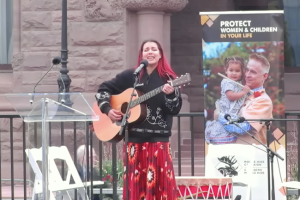
TORONTO — Long Lake #58’s Natasha Fisher shared a song she created during the Moose Hide Campaign Day’s Rally to End Violence, held May 14 at Queen’s Park in Toronto. Information about the 15th Moose Hide Campaign Day is posted online, and a video of the Rally to End Violence is posted on YouTube.
“A couple of years ago, there was so much information online that came to light about Missing and Murdered Indigenous Women,” Fisher says. “I wanted to do what I could to say and stand up for what I knew was going on, and it was when search the landfill was happening … in Winnipeg, and I felt disheartened, I felt heavy, I felt like I wanted to do something.”
Fisher adds that she felt that sharing about it on social media wasn’t enough.
“As an artist, I feel like we’re always looking for ways to find meaning in something or purpose or figure out a way or create our way out of something and I just couldn’t,” Fisher says. “It was heavy and I sat in my room and I wrote this song and it’s called: where do we go. The song is almost just like this feeling of hopelessness, of helplessness, but I know that with community and with people and with love and with others and with the help of each other, I don’t feel that hopelessness and that helplessness.”
Nipissing First Nation Elder and Oshkaabewis Perry McLeod-Shabogesic stressed the importance of the mooz (moose) during the opening of the Moose Hide Campaign Day’s General Plenary at the Royal Ontario Museum in Toronto. A video of the General Plenary is posted on YouTube.
“[I] want to remind everyone to think about that mooz, that creature, that fellow brother and sister that shares this land,” McLeod-Shabogesic says. “It’s very fitting I find that we have that as a part of the campaign because the mooz is one of the few animals that lives right across from that western door to the eastern door, northern door, southern door, that mooz is all across this land.”
McLeod-Shabogesic says the mooz carries the gift of kindness and love and family.
“As Anishinabek, and I think as Indigenous people across Turtle Island, we look to those animals like the mooz to emulate the way they are, the values they bring, and that mooz is one of those animals that carries that in such a good way,” McLeod-Shabogesic says.
Nipissing First Nation’s Bob Goulais, emcee at the Moose Hide Campaign Day in Toronto, stressed the importance of the Moose Hide Campaign’s message of ending violence against women, children, and those along the gender continuum during the General Plenary.
“It’s such an important message that we need to get out, that we need to end violence against women and girls and children,” Goulais says. “We need to live our life as men with gentleness and kindness, and we were reminded by Grandmother Renee (Thomas) this morning that it’s OK to show those tears, to cry — that’s a form of that water as well that will heal us and bring us that and remind us that we are a gentle part of creation as well.”
The Moose Hide Campaign Day also featured a Sunrise Ceremony led by Mi’kmaq Elder Thirly Levi, a keynote address by Niigaan Sinclair, a message of hope from Moose Hide Campaign co-founders Raven and Paul Lacerte, a keynote address by Theland Kicknosway and a fast-breaking ceremony at the Native Canadian Centre of Toronto.