

Anishinabek leaders provide details of energy initiatives at Toronto forum
By Sam Laskaris
TORONTO – First Nations in Ontario have more opportunities to participate in energy projects.
“There are a number of involvements by our communities within the energy sector,” said Anishinabek Nation Deputy Grand Council Chief Chris Plain. “So, that tells me one good thing. Everybody is aware of the opportunities. But it’s the challenges and the barriers that prevent everybody from getting on board.”
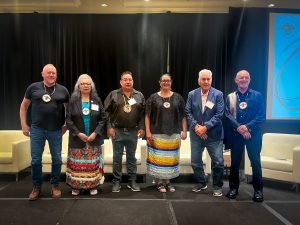
Deputy Grand Council Chief Plain made his comments at the Anishinabek Nation Energy Engagement Forum, held May 26-27 in Toronto. He was one of five Chiefs who spoke during the Anishinabek Nation Leadership Panel session at the forum.
Deputy Grand Council Chief Plain said there are abundant opportunities in the energy sector for First Nations.
“When we are presented these opportunities at home in our communities, we have to have total buy-in from our communities,” he said. “And so, in my case, when we go to talk to our community about hydro projects, we’re often reminded that some of our Elders were in the dark. There was no hydro in our communities where we’re living in a municipality where hydro is generated. We’ve been left behind.”
Deputy Grand Council Chief Plain said a plethora of opportunities should have existed in previous generations as well.
“But due to economic reconciliation, and we know that’s a buzzword, we are just now trying to catch up,” he said.
Deputy Grand Council Chief Plain said industry partners are not talking about true reconciliation since they often do not mention previous missed opportunities. Projects take time, and they can be complicated by the fact that there are leadership changes within communities, as elected terms can last from two to four years.
“There’s a lot of explaining that we have to do in our communities to get them to buy in,” he said. “That takes time. And time isn’t on our side a lot of times. We have to move to the speed of light, so to speak, sometimes.”
Deputy Grand Council Chief Plain also cautioned First Nations.
“We talk about opportunities for partnerships,” he said. “But a lot of times, the partnerships, they want to come and they want to control the partnership. They just want your endorsement, your money, your investment, and here’s your takeaway. This is what you’re going to get going down the road.”
He added that First Nations members are now more educated and can dictate terms.
“A lot of our communities now can run these operations,” he said. “And we need to do more than just being partners and just investing in these opportunities where we have joint ventures. We need to look to expand our opportunities, to be able to run these facilities.”
Deputy Grand Council Chief Plain also said a key barrier is often access to capital.
“We keep hearing that,” he said. “But what we’ve maybe failed to realize is that in some of our territories, we have limited access to collateral. We have infrastructure deficits, delayed federal funding approvals, restricted borrowing capacity.”
Anishinabek Nation Lake Huron Regional Chief Scott McLeod also provided information on what rightsholders in his region are saying about their participation in energy sector projects.
“There are increasing opportunities for our communities to get involved with major projects such as hydro transmission lines, solar projects, and wind projects,” he said. “But I think it falls short of being true equity partners in most cases. It’s opportunities that exist, but we’re still not at a level of treaty partner opportunities when dealing with a lot of these land-based energy sources.”
Lake Huron Regional Chief McLeod said that’s the case for hydroelectric initiatives, as well as for transmission of the hydroelectric, wind power, or solar projects.
“All of these things are generated from the land, generated from the land and the environment that we live in,” he said. “And treaties exist for a reason that our Ancestors saw as opportunities for us in perpetuity in our existence as First Nations in our territories. And these opportunities are not at a level where they should be and that’s in true partnership.”
Lake Huron Regional Chief McLeod said industry partners must realize they are not just working with First Nations and providing opportunities for small revenues or job creation.
“The treaty was based on sharing everything that this land can generate,” he said, adding the intent of treaties was to share everything and not to provide procurement policies of the government or private sector.
Anishinabek Nation Northern Superior Regional Chief Mel Hardy echoed the sentiment that First Nations must be treated as partners instead of being provided with “take-it-or-leave-it deals”, which governments still offer.
“In the last 10 years, I’ve seen a rise in our people when we’ve done mutual meetings and their response to the government,” he said. “And the rise is the education that our people are getting.”
Northern Superior Regional Chief Hardy also believes it is vital for First Nations to join forces with their colleagues.
“For us, it’s very important to recognize and to work with other First Nations,” he said, adding there are benefits to be gained from hearing different ideas and learning about others’ expertise.
Anishinabek Nation Southeast Regional Chief Marsha Smoke said it’s important to remember what exactly energy means.
“Energy is simply not electricity moving through wires for First Nations,” she said. “Energy affects whether we can build homes for our families, whether our water systems function, whether businesses can grow, whether our youth have employment opportunities close to home and whether our communities can move toward true self-determination.”
She also said she repeatedly hears First Nations do not simply want to be informed about projects after decisions are made.
“We want to be involved in shaping those decisions from the beginning,” she said. “This forum is important because relationship-building cannot happen one project at a time. It requires trust, respect and recognition that First Nations are governments and rightsholders, with a mission for our territories and future generations.”
Southeast Regional Chief Smoke also offered her thoughts on potential barriers to projects.
“We’ve got a number of challenges or a number of opportunities that are coming our way,” she said. “But we have to find that balance and be able to have that participation from our communities, not just through getting a good agreement. But we also need to be able to have our people available to tell them that there’s opportunities here to have jobs. We need to talk to our people in education to make sure that training opportunities are directed where they’re going to be able to see our young people come home after they are completing their secondary education pursuits.”
Anishinabek Nation Southwest Regional Chief Joe Miskokomon believes First Nations need to have a serious look at what their strengths are.
“For many, there needs to be a longer view of where this is going to get…A construction job has a start time and an end. And at that end of that time, what are your workers going to do? What are you actually going to be training for? How are you going to continue to have not just a boom and then a bust? How are you going to have a sustained economy that’s going to continue to thrive as it evolves?”
He offered his thoughts on how to proceed.
“We need to integrate not just trades,” he said. “We need to integrate science, technology, engineering, math. The STEM programs. We need to start introducing that at a very young level.”