

Filmmaker Cole Forrest talks ImagineNATIVE, Convenience Store NDN Zombie, and Nbisiing Naadziwin
By Ella Miller
TORONTO – The ImagineNATIVE Film + Media Arts Festival wrapped up on June 14, following two weeks of film programming and events that highlighted Indigenous filmmakers from all over the world.
This year’s ImagineNATIVE festival showcased 20 full-length feature films, 82 short films, and 23 digital or audio pieces. These works were created by artists from 56 nations in countries including Australia, New Zealand, Taiwan, Mexico, Ecuador, and Sweden.
The in-person portion of the festival took place between June 2 and 7 at TIFF Lightbox theatre, which is the headquarters for the Toronto International Film Festival (TIFF) and serves as a venue for other film screenings and smaller specialty film festivals throughout the year, while the ensuing online festival happened between June 8 and 14.
Cole Forrest was one of many Anishinabek filmmakers whose work was featured at the festival.
Forrest, who is from Nipissing First Nation, was joined on the ImagineNATIVE roster by other creators, including: Kile M. George, also from Nipissing First Nation (Little Orange Bandages); Isaac Murdoch of Serpent River First Nation (Nenaboozhoo); Esbikenh of Walpole Island First Nation (Migizi Makes A Deal With Gzhemnidoo); and Tanya Talaga, who has roots in Fort William First Nation (Ni-Naadamaadiz: Red Power Rising).
Forrest’s short film, Convenience Store NDN Zombie, premiered at TIFF Lightbox on June 4 as part of Crack-ups, ImagineNATIVE’s comedic shorts series. It was later available online as part of the Otherworldly lineup, which assembled a collection of films with supernatural themes.
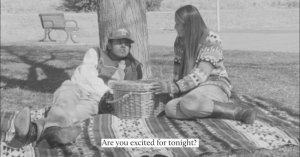
Convenience Store NDN Zombie is a revenge movie parody that follows Zoe and Benny, a dysfunctional couple whose lives are turned upside down when Benny is transformed into a zombie right before Halloween night.
“As an Indigenous filmmaker, I love putting humour [in my films],” says Forrest, on their short, which includes a shot of a zombie eating a large plate of spaghetti. “Humour is a big part of culture. I feel like the more heinous and ridiculous a scenario is, the more you can really have comedy with it.”
Forrest used vintage film-making techniques in the production of Convenience Store NDN Zombie, including shooting in black and white on 16mm film. They also chose to omit audible dialogue in the film, feeling that ImagineNATIVE, which showcases films in over 50 different Indigenous languages, was an environment conducive to subtitles.
Though Forrest is from Nipissing First Nation, they currently live in New Mexico, which is where they shot Convenience Store NDN Zombie, which features Tewa talent in front of and behind the camera.
Still, Forrest says that they are still heavily influenced by growing up in Norhtern Ontario, even shooting their first-ever films there.
“There’s a word for that, which is ‘Naadziwin,’ it means ‘way of life,’ and the Nbisiing Naadziwin is sort of always with me,” says Forrest. “I carry a lot of my teachings in my way of life, and I try to represent Nipissing wherever I go.”
Forrest recalls growing up not knowing many Indigenous filmmakers, but over time, finding numerous mentors in the field through initiatives like ImagineNATIVE and other film programming gigs.
“If you are a young Anishinabek person or a filmmaker, stick with it,” they say. “There are a lot of amazing older Anishinabek artists out there to mentor you. Those older Anishinabek artists mentored me and encouraged me to just keep going and to find my sense of self wherever I went, including my mom.”
Forrest is currently developing a feature-length film inspired by classic queer and low-budget horror movies. In the meantime, they continue to produce short films, some of which are available via their Instagram: @cole.forrest.art.
Select ImagineNATIVE programming will continue throughout the year, including exhibitions at A Space Gallery, Gallery 44 Centre for Contemporary Photography and Gallery TPW, all in Toronto.