

Fort William First Nation celebrates its 7th Annual Culture Camp
By Rick Garrick
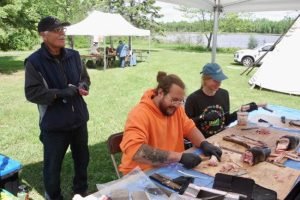
THUNDER BAY — Wiikwemkoong Unceded Territory Elder Andrew Mandamin enjoyed sharing his knowledge about making tools from moose bones during Fort William First Nation’s 7th Annual Culture Camp held June 17-21, at Chippewa Park on Lake Superior in Thunder Bay, Ontario.
“I’ve been working with these moose legs for about five years,” Elder Mandamin says. “It’s very rewarding — I found that doing this work is very therapeutic. I went through grief, and this is what got me through my grief. If somebody was going through a hard time, I would highly recommend taking up this kind of work.”
Elder Mandamin says he was working on a migoos (awl), and he also had a de-fleshing tool he had made from a hind leg bone.
“Women use this [migoos] in their hair,” Elder Mandamin says. “Some of these, I sharpen them up. You can use it for poking holes when doing birch bark work and on deer hides, but also people that carry pipes, they use these for cleaning their pipes.”
Fort William’s Larissa Speak enjoyed co-instructing with the deer hide tanning apprenticeship program during the camp.
“We have seven or eight people who are here for the full five days, so we’ve been taking…six deer hides kind of from start to finish,” Speak says. “Now it’s a nice sunny day and they’re working on softening those hides, and once that’s done we’ll do the final smoke.”
Speak says she first got involved with the hide camp about three years ago as a participant.
“This is a really great way for people to reconnect, it’s a very welcoming environment,” Speak says. “There’s school tours coming through — they go around and do a tour, and everybody talks to them about the different things that are happening at each station.”
Red Rock Indian Band’s Cecilia Person, Anishinaabemowin teacher at St. Anne Elementary School, says she brought her Grade 6 class to the camp.
“It’s important to bring them out so they can learn more about the Anishinabek culture in a hands-on land-based teaching,” Person says. “The students are really enjoying the day so far and learning a lot of things they’ve never seen before, so I think it’s a great opportunity for them—a great learning experience for them.”
Fort William’s Jeordi Pierre says he shared some knowledge about the preparation of a goose and dumplings meal during the camp.
“Sometimes, some of our people shy away from liver and kidneys and heart and stuff like that, but if it’s prepared properly, you actually enjoy it,” Pierre says. “Today, I’m here to share a little bit about harvesting a goose and making one of our main menus.”
Keira Loukes, whose father is an Alderville First Nation citizen, says the camp was awesome.
“It’s great to come every year, it’s extra special this year because my daughter is old enough to bop around and watch what is going on,” Loukes says. “She has hung out a little bit to hear some moose teachings from [Elder] Kaaren (Dannenmann), then she went to the language immersion program a little bit, still just waddling around, and then has just been watching. I think that’s so valuable, just to watch people doing the fleshing, watching them pull the hide and then she even got to be on the hide (for the trampoline hide stretching technique).”
Tim Nason, a visitor from Vancouver Island whose family is from Fort William First Nation, says he was learning about the culture and practices his family used to do at the camp.
“The family did a lot of work with the leather and hides back in the day, so it’s interesting to be able to take part in that and attend the courses that they have here,” Nason says. “It’s pretty satisfying; some of it’s hard work, but it’s been quite nice to see it transform into this leather product.”
Fort William First Nation’s 7th Annual Culture Camp included a full five-day immersive Anishinaabemowin program taught by Cassandra Spade and Bimikawe. Participants were encouraged to only speak Anishinaabemowin during the camp.