

Fort William First Nation honours Indian Residential School Survivors, their families, and those who never returned home
By Rick Garrick
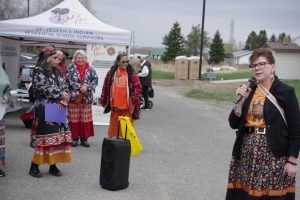
FORT WILLIAM — Fort William’s Honour Gathering was held by the St. Joseph’s Indian Residential School Survivor Project and SJIRS Survivor Council on May 23 in honour of Indian Residential School Survivors and children who never made it home.
“It’s an honour gathering and it’s in acknowledgement of the 215 that were discovered in 2021,” says Fort William Chief Michele Solomon. “This is the fifth anniversary of that date, so this is our day to commemorate that and to bring together our Elders and our kids and just acknowledge the impacts of Residential School.”
Chief Solomon says the gathering also provided a space for Elders, children, and families to get together and have fun in a safe place.
“There’s some surveys happening, too, to get information about our comprehensive community planning,” Chief Solomon says. “This is all towards honouring Survivors and families of Survivors and just really providing a safe space to be together and acknowledge the history.”
Fort William Councillor Desiree Morriseau-Shields says it is important to continue to remember and honour those affected by the Indian Residential School System.
“We’ve got our young kids here, we’ve got our parents, our Elders here, so we’re all here to share stories and gather together to reflect on this day,” Morriseau-Shields says. “My kids are here today, too, to enjoy some of the activities, including this (mechanical bull ride). Lots of kids are here, so that’s good, we’re going to be doing [a] drum ceremony in a bit to open and share some words.”
Sheri Boucher, director of Community Well-being at Fort William, says the SJIRS Survivor Council brought in the fun activities to honour what they didn’t have when they were children.
“We’re really proud that we are able to come together as a community to heal — we wrap our love and support around them and we honour them, as well as our Knowledge Keepers,” Boucher says, noting that the gathering has been getting bigger each year. “A lot of our community is coming not just from on our First Nation, but in the surrounding area as well.”
Chief Solomon says in her opening remarks that many other potential burial sites have been discovered at Indian Residential School sites across the country since the 215 were discovered in 2021 in Kamloops, B.C.
“This day today, it’s about the Survivors, so I really want to say to the Survivors, I want to acknowledge their experiences and chi-miigwech for your sharing of your experiences with us,” Chief Solomon says. “It helps us as a community to learn and grow and to understand what that experience has been like, to help us understand how the intergenerational impacts have played themselves out in our community.”
Chief Solomon adds that it is important to acknowledge the work that the SJIRS Survivor Council continues to do.
“I know that at times, it’s probably been really difficult and really challenging to talk about the experiences that happened in Residential Schools, the inhumane treatment of our children, of our families, the way our children were taken from their families,” Chief Solomon says. “We can only hope that families do get some closure, some peace from some of the research that’s been happening, but most importantly, I think for our communities, we have a better understanding and we’re learning how we can make things better for intergenerational Survivors and really help our children understand the experience that has happened and how that has impacted them.”
Fort William Councillor Yvette Greenwald says during her opening remarks that the St. Joseph’s Indian Residential School opened in 1870 at the community’s original Mission Village along the Kaministiquia River before moving to Arthur and Franklin Streets in Thunder Bay, where it was closed in 1970.
“That is a hundred years of operation, and that is a century too long as it affected the lives of Fort William First Nation people, including my own family,” Greenwald says. “My father attended St. Joseph’s along with his siblings, with other members from Fort William First Nation, maybe even your own parents, your grandparents, or your great grandparents. Today, everyday, we honour the children who attended IRS school for they have overcome the legacy that should never be forgotten.”